


Industrial Electrical Solutions
What is Partex Marking Systems and How Do They Work? A Complete Guide
Discover how Partex Marking Systems simplify cable and wire identification in industrial environments. This guide explains their working principles, key applications, benefits, and why they are widely used in electrical panels, automation systems, switchgear, and industrial installations. Learn how the right marking system improves safety, maintenance efficiency, and long-term reliability.

Jenxkaro
Jul 13, 2026
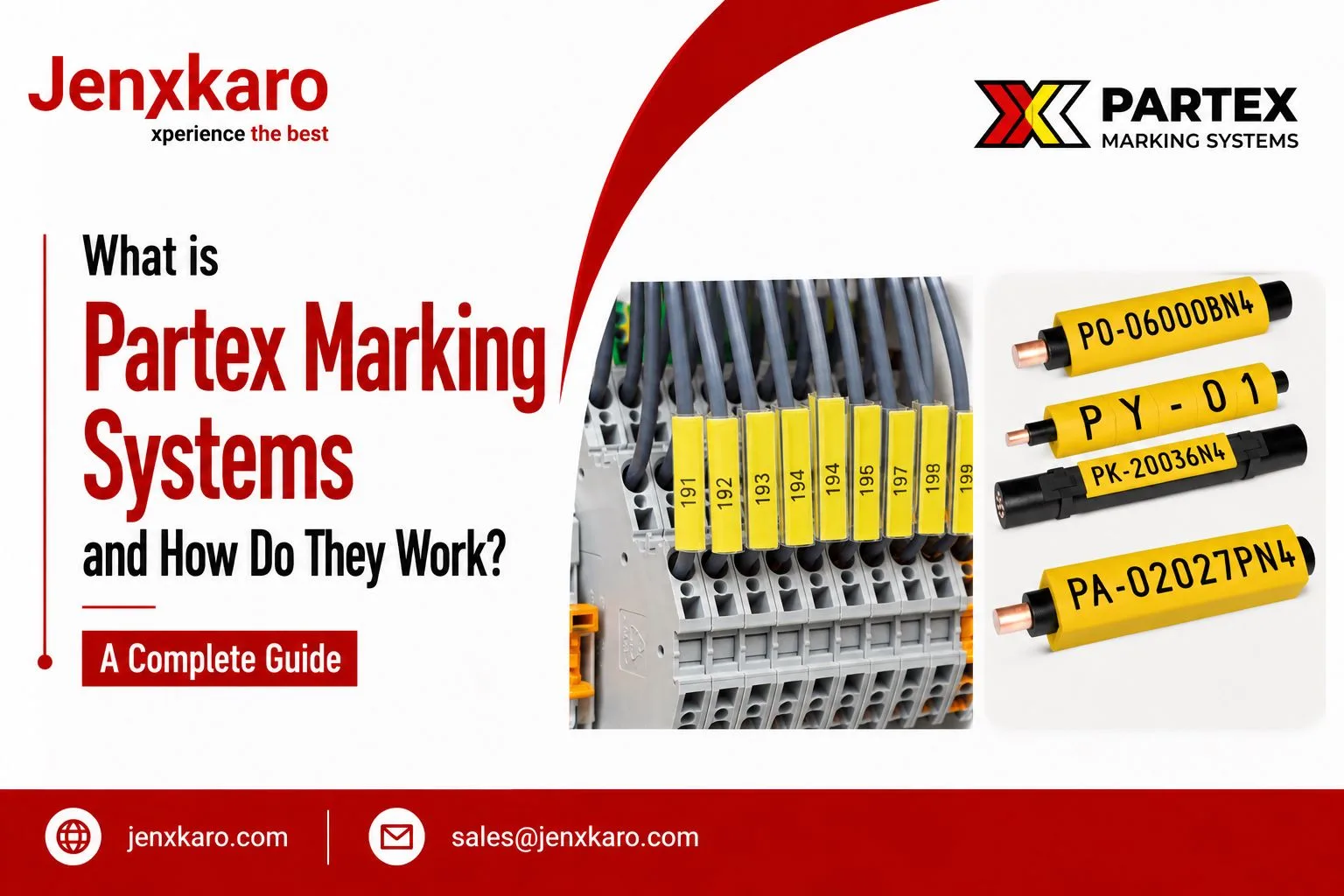
If you've ever opened a control panel and found a tangled mess of unlabeled wires, you already know why identification matters. Partex Marking Systems solve exactly that problem — and they've been doing it for over 75 years across industries ranging from power generation to shipbuilding.
For panel builders, procurement managers, and automation engineers, choosing the right Wire Marking Systems isn't just about tidiness. It's about safety, faster troubleshooting, and compliance with electrical standards. This guide walks through what Partex actually offers, how their products work, and where they fit into modern panel wiring and industrial projects.
What is Partex Marking Systems?
Partex Marking Systems is a family-owned manufacturer with three generations of experience in industrial identification. The company designs and produces markers, marking machines, and accessories used to identify wires, cables, pipes, and panel components across dozens of industries.
Their catalog spans cable marking systems, terminal and component markers, heat shrink sleeves, self-adhesive labels, and dedicated marking printers like the Primacy card printer and MK-10 series. What sets Partex apart is the sheer range of formats — closed markers, open profile markers, tie-on markers, and clip-on options — each engineered for a specific mounting situation rather than a one-size-fits-all approach.
In India, Partex operates through Partex Marking Systems India Pvt. Ltd., headquartered in Bengaluru, and through a network of authorized distributors who supply genuine products with technical backing. This is where Terminal Block Marking India buyers usually start their search — looking for a supplier who understands both the product line and local project requirements.
How Do Partex Marking Systems Work?
At a functional level, cable identification with Partex products comes down to three components working together:
- The marker or label — the physical piece that carries the printed text or code
- The printing method — thermal transfer, hot stamping, or laser etching, depending on the marker type
- The mounting mechanism — how the marker attaches to the wire, cable, or terminal without slipping
Take the PA/PAZ series as an example. These are closed, adjustable sleeve markers built with a spring-effect profile that grips cables across a wide diameter range. They're resistant to liquid fuel exposure and flammability, which makes them suitable for demanding industrial environments, not just office-grade panels.
Then there's the PCT marker, sized specifically to sit flush against terminal block widths — a small detail, but one that matters enormously when you're trying to keep a panel door closing properly over dozens of tightly packed wire ferrules and terminals.
The result is a system where every marker type has a defined use case, rather than forcing electricians to improvise with generic labels that peel, fade, or fall off within a year.
| Types of Partex Markers | ||
| Marker Type | Best Suited For | Notable Feature |
| PA/PAZ (Closed sleeve) | Loose or unconnected cables | Adjustable, fuel-resistant |
| PO/POZ (Oval profile) | Cables 1.3mm–2.8mm | Direct cable-tie mounting |
| PCT (Terminal marker) | Terminal block wiring | Fits 1.2mm–4.0mm diameters |
| Open profile markers | Already connected/terminated wires | Snap-in latch installation |
| Heat shrink markers | Harsh or high-vibration environments | Permanent, shrink-fit hold |
| Self-adhesive labels | Modular components, fuses, switches | Printed via portable Partex printers |
This variety is precisely why industrial cable markers from Partex are specified across such different sectors — a marine electrical panel and a solar farm junction box have almost nothing in common structurally, yet both need markers that won't degrade under their respective conditions.
Partex vs Generic Cable Markers
Procurement teams often ask whether a cheaper, unbranded marker can do the same job. In most cases, the honest answer is: not quite.
Generic markers typically:
- Use lower-grade plastics that crack or discolor with heat exposure
- Lack a dedicated print-and-mount system, forcing manual writing or generic label printers
- Come in limited sizes, leading to loose fits on non-standard cable diameters
Genuine switchgear labeling and terminal marking from Partex, by contrast, is engineered around real cable and terminal dimensions, tested for working temperatures from -40°C to 90°C, and — where required — available in halogen-free variants for public buildings and utilities. For projects where electrical safety and long-term legibility matter, that engineering difference tends to show up within the first year of use, not immediately.
Industry Use Cases
- Power generation — marking switchgear, transformers, and overhead lines for fast fault isolation
- Industrial automation — identifying wiring inside control cabinets, panels, and robotic stations
- Marine and offshore — stainless steel and corrosion-resistant markers for harsh environments
- Railways and transport — durable identification for onboard electrical systems
- Telecommunications and BMS — halogen-free markers for ICT and building automation systems
Each of these sectors has different regulatory and environmental demands, which is exactly why a modular product range — rather than a single universal marker — makes practical sense.
Best Practices for Cable and Wire Identification
- Match the marker to the environment, not just the cable size — outdoor, marine, or high-heat settings need specific material grades.
- Standardize your labeling format across projects so any technician can read a panel without a legend.
- Use terminal-specific markers like PCT for terminal blocks instead of adapting general-purpose labels.
- Print rather than hand-write wherever volume allows — it's faster and far more consistent.
- Keep a spare stock of common marker sizes on hand for maintenance and retrofits.
Following cable labelling standards consistently reduces downtime during fault-finding and makes future panel modifications considerably easier for whoever inspects the system next.
Key Takeaways
- Partex Marking Systems offers a purpose-built range for wire, cable, and terminal identification.
- Marker type should be chosen based on cable diameter, mounting method, and environment.
- Genuine Partex components are tested for temperature resistance and durability, unlike many generic alternatives.
- Consistent panel wiring labels improve safety, reduce troubleshooting time, and support long-term maintainability.
- Jenxkaro is an Authorized Partex Marking Systems Distributor in India, supplying genuine products with technical guidance.
Conclusion
Good cable identification isn't an afterthought — it's part of how a panel or installation performs over its entire working life. Partex Marking Systems brings decades of engineering focus to a problem that's easy to underestimate until something goes wrong at 2 a.m. during a fault call.
Whether you're specifying markers for a new control panel, retrofitting an older switchgear room, or standardizing labeling across multiple sites, choosing the right marker type — and sourcing it from a genuine supplier — makes a measurable difference.
Ready to source genuine Partex products for your next project? Jenxkaro, as an Authorized Partex Marking Systems Distributor in India, offers original Partex markers, machines, and accessories with expert product selection, competitive pricing, and pan-India delivery. Reach out to our team to find the right marking solution for your application.
Tagged
Jenxkaro
India's 1st electrical components and accessories marketplace.
Frequently asked questions
1. What are Partex Marking Systems used for?
They're used to identify wires, cables, terminals, and panel components, helping electricians and technicians quickly trace connections during installation, maintenance, or fault-finding.2. Are Partex markers suitable for outdoor installations?
Yes. Several Partex markers are built with fuel-resistant, corrosion-resistant, or stainless-steel materials designed specifically for outdoor, marine, and offshore conditions.3. What's the difference between PA/PAZ and PO/POZ markers?
PA/PAZ markers are closed, adjustable sleeves for unconnected cables, while PO/POZ markers have an oval spring-action profile suited to a narrower diameter range and direct cable-tie mounting.4. Can Partex markers be printed on-site?
Yes. Partex offers dedicated printers, including the Primacy card printer and MK-10 series, along with portable printers for on-site labeling of self-adhesive markers.5. Do Partex products come in halogen-free versions?
Yes. Many markers are available in halogen-free, cadmium-free, and silicone-free variants, particularly important for public buildings and utility installations.6. How do I choose the right marker for terminal block wiring?
The PCT marker is purpose-built for terminal blocks, available in sizes covering 1.2mm to 4.0mm cable diameters, and designed to sit flush against terminal block widths.7. Where can I buy genuine Partex products in India?
Genuine Partex products are available through authorized distributors. Jenxkaro is an Authorized Partex Marking Systems Distributor in India, offering original products with technical support and pan-India delivery.