


Wiring & Cable Accessories , Cable Ties
Cable Tie Specifications Explained: Size, Material, Flame Rating & Colour Guide for Industrial Buyers
"Flame rated" and "heat stabilized" aren't marketing words — they describe real material differences that decide whether a cable tie survives its application. Here's what each spec actually means.

Jenxkaro
Sep 08, 2026
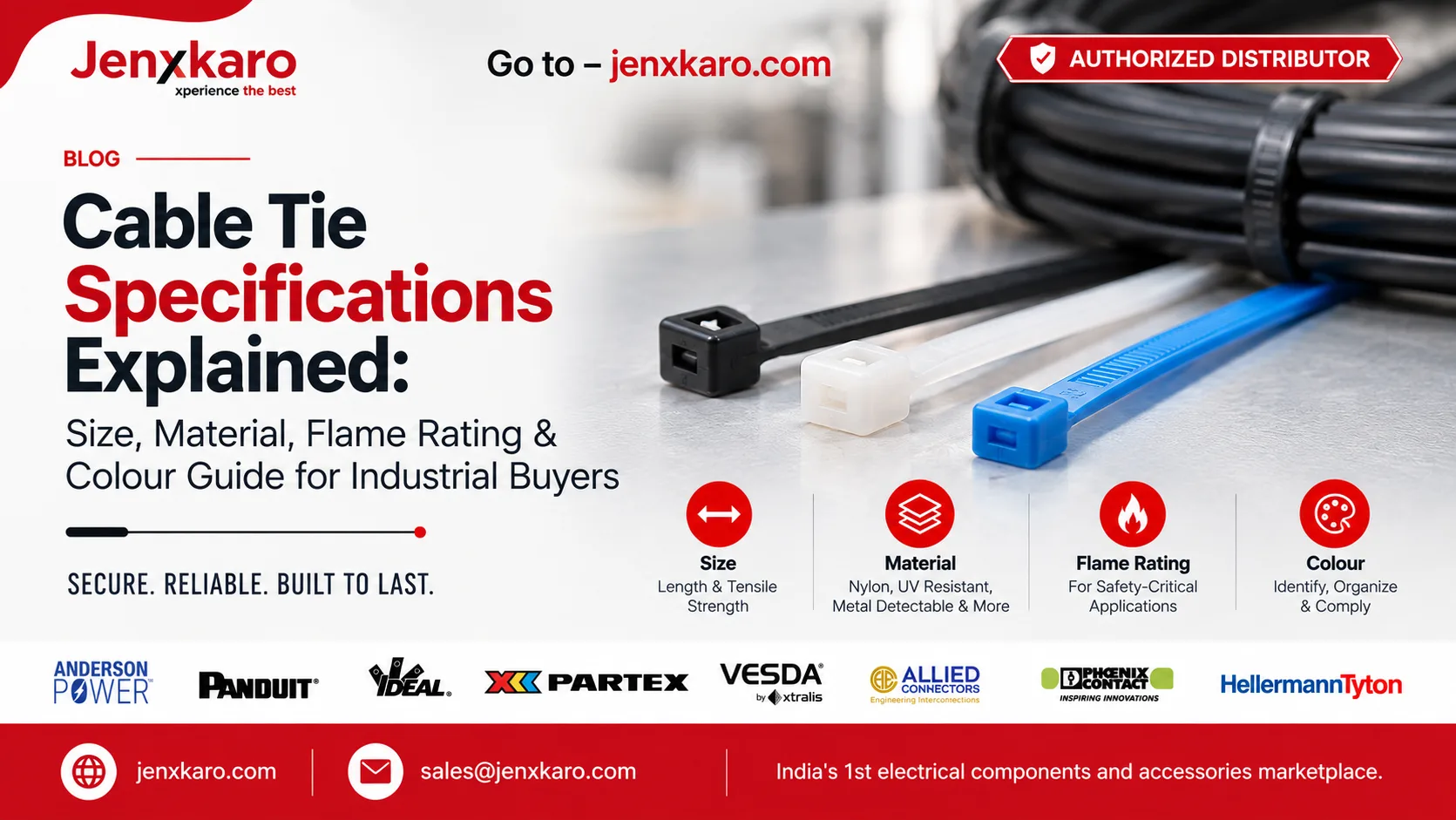
Read a cable tie's spec sheet and you'll find a handful of details that look minor but decide whether the thing actually survives its job — the base material, whether it's rated for flame exposure, whether it's built to tolerate heat, and even something as simple as its colour. None of these are cosmetic choices. Get one wrong and a tie that looks identical to the correct one will crack, discolour, or fail well ahead of schedule. This guide walks through what each specification actually means, with real part numbers along the way so the differences stay concrete rather than theoretical.
Natural Nylon vs. Black: A Functional Choice, Not Just a Colour One
It's easy to assume the colour of a cable tie is purely aesthetic, but in practice it usually signals whether the material has been UV-stabilized. Natural (uncoloured) nylon — the kind used in ties like the Hellermanntyton T18I (145X2.5)NATURAL, T30L(190*3.5) NATURAL, and T30R(150*3.6) NATURAL — is a fine choice for panels and enclosures that never see sunlight, but it isn't the right pick once UV exposure enters the picture. Black nylon ties, such as the T30L(190*3.5)BK and T50I(300*4.6)BK, carry UV stabilization as standard — which is why black is usually the safer default whenever there's any doubt about sun exposure down the line.
Flame Rating: What UL94 V0 Actually Certifies
Flame rating is a different property altogether from heat tolerance, and it's worth not confusing the two. UL94 V0 specifically certifies that a material is self-extinguishing — it stops burning within a defined window once a flame source is removed. That matters wherever a panel or enclosure has to meet fire-safety compliance requirements, not just wherever heat happens to be present. Hellermanntyton's T18R V0(100X2.5) and T30R-V0 (150X3.5) both carry this V0 rating, and neither should be substituted with a standard, non-rated tie in an application where compliance is mandatory — even if the tensile strength on paper looks comparable.
Heat-Stabilized Formulations for Sustained High Temperatures
Heat stabilization is its own separate spec, distinct from flame rating. It refers to an additive in the nylon that resists embrittlement under continuous elevated temperature — useful anywhere a tie sits near a motor, heat exchanger, or other warm component, even where there's no fire risk involved at all. The T30L-HSB [111-03450] and T18R (100X2.5)HS BK are both formulated this way, and they're the right call anywhere sustained warmth — rather than an open flame — is the concern.
Not All Black Ties Are Built for the Outdoors
Standard UV stabilization on a black tie is enough for occasional sun exposure, but it isn't the same as a dedicated weatherproof formulation designed for years of continuous outdoor service. The T18R/W (100X2.5) UV is built specifically for that longer exposure window, which is worth knowing before assuming any black tie will hold up outdoors indefinitely.
When Size Is the Spec That Actually Matters
Sometimes the deciding factor isn't material at all — it's physical size. In densely packed instrumentation panels or compact wiring harnesses, a bulky standard-width tie head can physically collide with neighbouring components regardless of how strong it is. That's the gap filled by low-profile and miniature designs like Panduit's PLP1.5I-M and PLT1.5M-C0, both built for tight-clearance bundling where a standard tie simply wouldn't fit the space.
| Quick Comparison | ||||
| Part Number | Brand | Spec Highlight | Best Suited For | Price |
| T18I (145X2.5)NATURAL | Hellermanntyton | Natural nylon | Indoor bundling, no UV exposure | 6.00/- pc |
| T30L(190*3.5) NATURAL | Hellermanntyton | Natural nylon | Indoor bundling, no UV exposure | 10/- pc |
| T30R(150*3.6) NATURAL | Hellermanntyton | Natural nylon | Indoor bundling, no UV exposure | 2.50/- pc |
| T30L(190*3.5)BK | Hellermanntyton | UV-stabilized (black) | General bundling with some sun exposure | 14/- pc |
| T50I(300*4.6)BK | Hellermanntyton | UV-stabilized (black) | Larger bundles with some sun exposure | 8/- pc |
| T18R V0(100X2.5) | Hellermanntyton | UL94 V0 flame-rated | Fire-safety-compliant panels | 10/- pc |
| T30R-V0 (150X3.5) | Hellermanntyton | UL94 V0 flame-rated | Fire-safety-compliant panels | 15/- pc |
| T30L-HSB [111-03450] | Hellermanntyton | Heat-stabilized | Sustained elevated-temperature zones | 20/- pc |
| T18R (100X2.5)HS BK | Hellermanntyton | Heat-stabilized | Sustained elevated-temperature zones | 3/- pc |
| T18R/W (100X2.5) UV | Hellermanntyton | UV/weather-resistant | Extended outdoor exposure | 3/- pc |
| PLP1.5I-M | Panduit | Low-profile | Space-constrained instrumentation panels | 10/- pc |
| PLT1.5M-C0 | Panduit | Miniature | Compact wiring harnesses | 5/- pc |
Availability & Sourcing
Jenxkaro is an authorized distributor supplying these products to customers across India, with bulk order quantities available on request. None of the products covered in this guide have a verified on-page reference price at this time, so pricing is best confirmed directly with Jenxkaro rather than stated here — the same goes for current stock, which varies by part number and order quantity and is worth checking at the time of enquiry.
Tagged
Jenxkaro
India's 1st electrical components
Frequently asked questions
Is a black cable tie always UV-resistant?
Not necessarily. Standard black nylon typically carries basic UV stabilization, but dedicated UV/weather-resistant variants are formulated for longer sustained outdoor exposure — worth checking the specific product's rating rather than assuming colour alone tells you this.What does UL94 V0 mean on a cable tie?
It's a flammability rating indicating the material is self-extinguishing within a specified time after a flame source is removed — relevant for panels or enclosures built to fire-safety compliance requirements.Is a heat-stabilized tie the same as a flame-rated tie?
No. Heat-stabilized refers to resistance to embrittlement under sustained elevated temperature, while flame rating refers to how the material behaves when directly exposed to fire. A tie can be one, both, or neither.Why choose a low-profile or miniature tie over a standard one?
When physical space is the constraint — tightly packed panels or compact harnesses — a bulkier standard tie head can interfere with nearby components even if its tensile strength would otherwise be sufficient.