


Cable & Wiring Accessories
Types of Industrial Cable Connectors Explained: Circular, Power, Compression & Retention Connectors
Not every cable connector does the same job — some carry power, some carry signal, some just tap into a line you don't want to cut. Here's how the main types differ and where each one belongs.

Jenxkaro
Sep 15, 2026
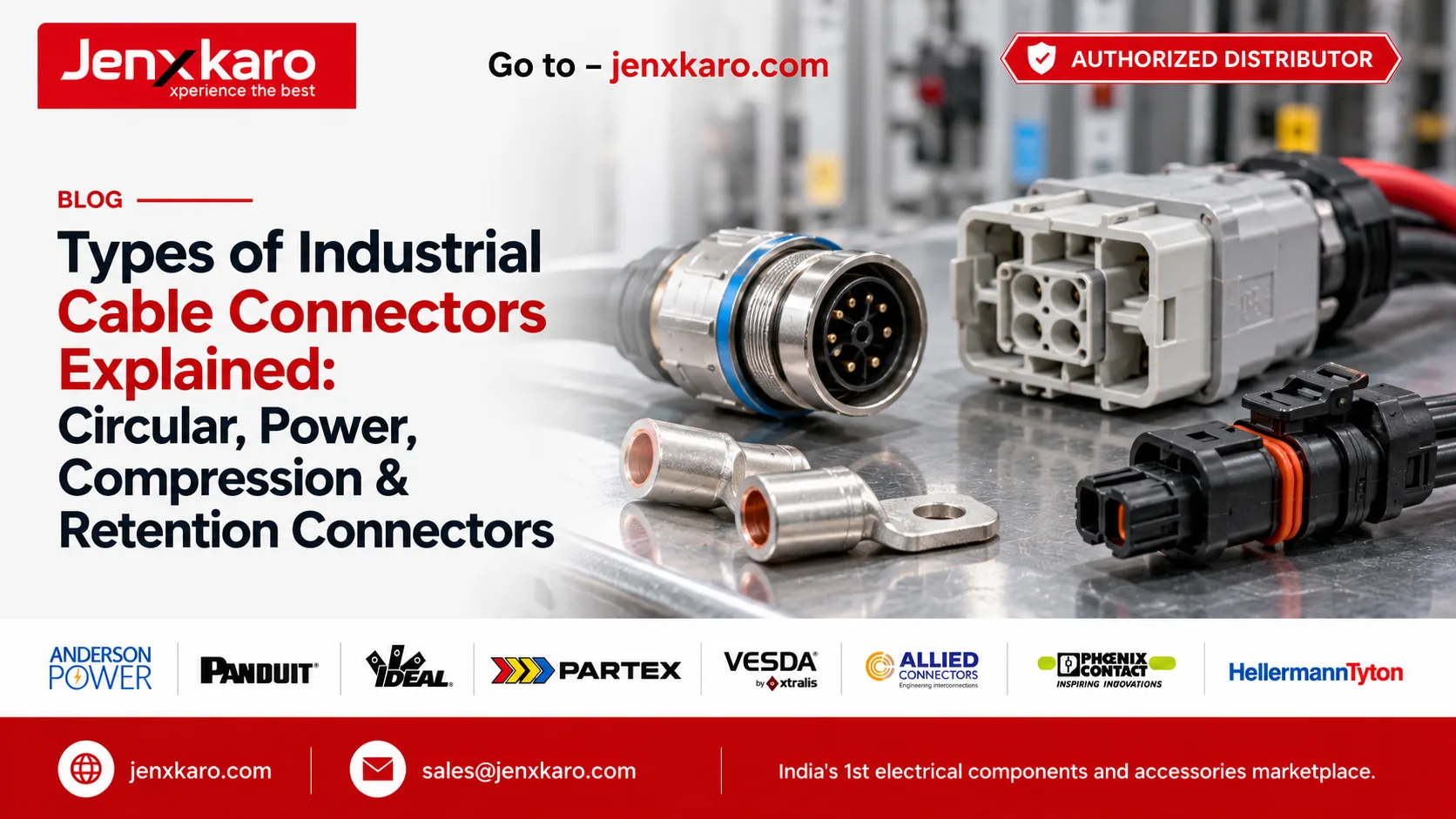
Not every cable connector does the same job. Some carry high current, some carry signal or data, some tap into an existing line without cutting it, and some aren't electrical at all — they just hold another connector in place. This guide walks through the main types of industrial cable connectors, what each one is actually built for, and where the real differences matter when you're specifying one for a job.
Power Connectors: Built for High Current, Not Just Any Connection
A power connector's job is to carry significant current safely, which means its design priorities — contact material, arc protection, touch-safe housing — differ from a connector meant only for signal or data. The Saf-D-Grid series from Anderson Power Products, such as the 2058KH2-BLUE-BK Saf-D-Grid Connector , is a good example: it's built for direct-current power distribution in applications like DC micro-grids and data-centre power trains, with a touch-safe housing that can be handled without exposing anyone to live contacts even at several hundred volts. Where an application genuinely needs this class of connector, a lighter-duty signal connector isn't a safe substitute, regardless of how similar the housing might look.
Circular Connectors: M23 and M16, and Why the Size Difference Matters
Circular connectors in the M23 and M16 families are the workhorses of industrial automation — panel-mount and cable-mount connectors used for signal and data transmission between machines, sensors, and control panels. The "M" number refers to the connector's thread diameter in millimetres, and the larger M23 format generally supports more pins and higher current per contact than the more compact M16, which is why designers reach for M16 when panel space is tight and M23 when the application needs more signal channels or current capacity.
Hummel's 7106600000 Housing cable connector M23 Signal is a cable-side signal connector in the M23 range, while the 7400000000 Housing panel connector and 7492000000 are its panel-mount counterparts — the cable-versus-panel distinction matters because one terminates a cable run and the other mounts through an enclosure wall. On the smaller M16 side, the 7810300000 is the cable-mount version and the 7840000000 connector its panel-mount equivalent, following the same logic in a more compact footprint. Both families are commonly rated for IP67/IP69K ingress protection, worth checking against your enclosure's actual exposure rather than assumed.
Compression Connector Taps: Connecting Without Cutting the Line
A compression connector tap creates an electrical connection onto an existing conductor without cutting or splicing the main run — a mechanical compression fitting clamps the tap conductor directly onto the carrier line. Panduit's HTCT250-2-1 Compression Connector Tap is this type of connector, typically used for grounding, bonding, or branch connections where disturbing the main cable run isn't practical. It's a fundamentally different job from either connector type above — not terminating a cable end, but branching off an existing one.
Connector Clips: Keeping a Connection From Working Loose
A connector clip isn't a connector in the electrical sense at all — it's a mechanical retention accessory that holds a connector housing securely to a surface or DIN rail so vibration or accidental pulling doesn't disconnect it over time. Hellermanntyton's CC08 Connector clip serves this purpose, and it's the kind of small component that's easy to overlook in a design until a connector works loose in the field from vibration a clip would have prevented.
Quick Comparison
| Part Number | Brand | Connector Type | What It's For |
| 2058KH2-BLUE-BK | Anderson Power Products | Power connector (Saf-D-Grid) | High-current, touch-safe DC/AC power connection |
| 7106600000 | Hummel | M23 cable connector, signal | Cable-side signal/data termination |
| 7400000000 | Hummel | M23 panel connector, signal | Panel-mount signal/data connection |
| 7492000000 | Hummel | M23 panel connector | Panel-mount, general M23 applications |
| 7810300000 | Hummel | M16 cable connector | Compact cable-side termination |
| 7840000000 | Hummel | M16 panel connector | Compact panel-mount connection |
| CC08 | Hellermanntyton | Connector clip | Mechanical retention, vibration resistance |
| HTCT250-2-1 | Panduit | Compression connector tap | Tap/branch connection without cutting the main line |
Availability & Sourcing
Jenxkaro is an authorized distributor supplying this full range through its Cable Connectors category, to customers across India, with bulk order quantities available on request. Pricing and current stock are best confirmed directly with Jenxkaro rather than stated on-page, since availability varies by part number and order quantity.
Tagged
Jenxkaro
India's 1st electrical components
Frequently asked questions
What's the difference between an M16 and an M23 connector?
Both are circular connectors used mainly for signal and data in industrial automation, but M23 generally supports more pins and higher current per contact, while M16 has a smaller footprint — the right choice depends on available panel space and how many signal channels the application needs.What is a compression connector tap used for?
It creates an electrical connection onto an existing conductor without cutting or splicing the main run, commonly used for grounding, bonding, or branch connections.Is a connector clip an electrical component?
No — it's a mechanical retention accessory that secures a connector housing in place, protecting against vibration or accidental disconnection rather than carrying current itself.Can a signal connector be used in place of a power connector?
No. Power connectors are built with contact materials, arc protection, and touch-safe housings specifically rated for higher current — a signal connector isn't a safe substitute even if the physical housing looks similar.