


Cable tie installation tools ( Cable ties)
Cable Tie Size and Length Chart: How to Choose by Bundle Diameter and Tensile Strength
Not sure which Panduit cable tie to buy? Use this cable tie size chart to match length, bundle diameter and tensile strength, with part numbers available from Jenxkaro.

Jenxkaro
Oct 28, 2026
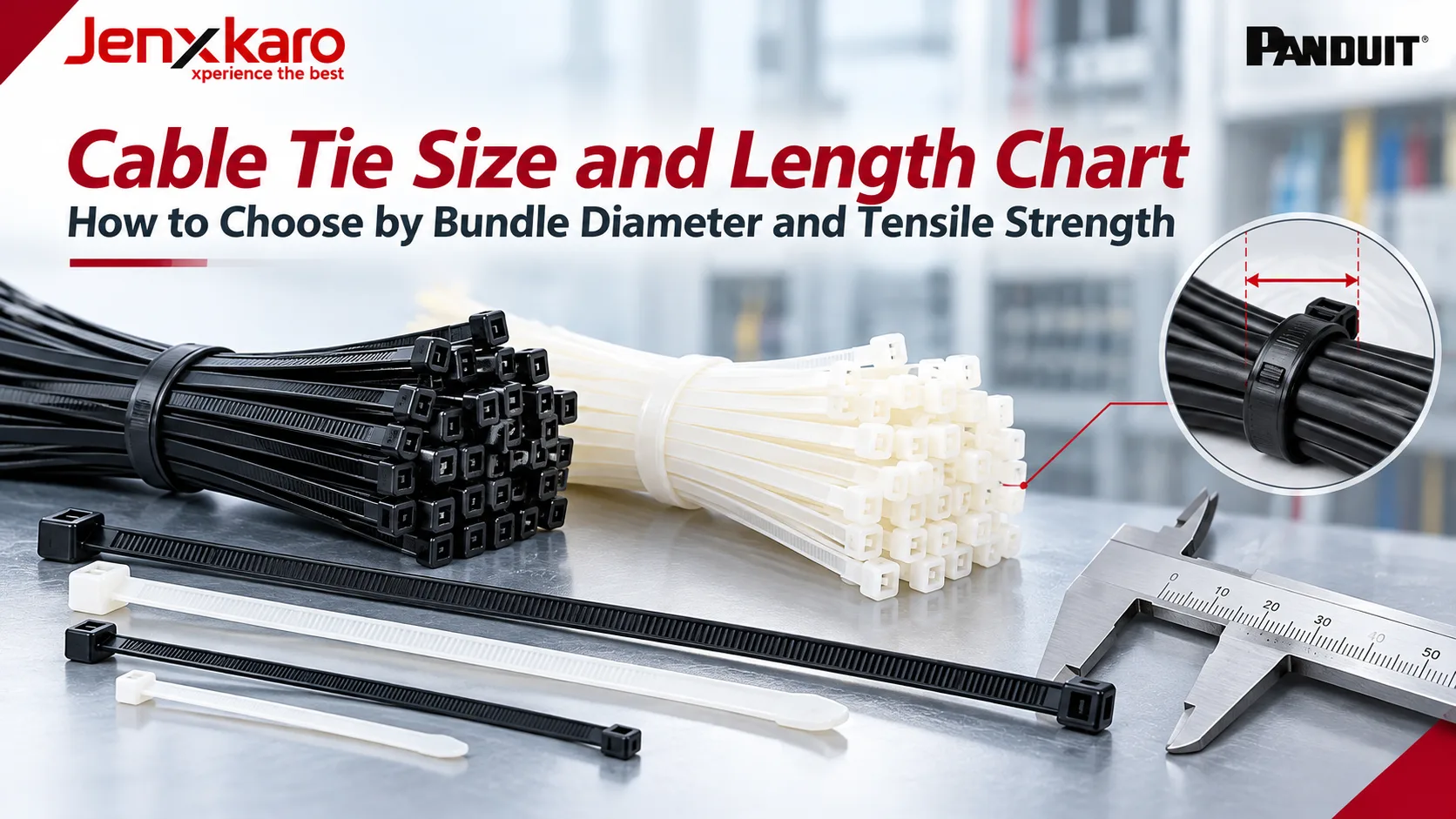
A Panduit cable tie looks like the simplest item on a panel bill of materials, until a tie turns out 20 mm too short for the bundle, or a thin tie gives up on a hot outdoor run. Length, width and strength each decide whether a tie holds for years or fails in a month. This guide shows how to read a cable tie size chart, how to match a tie to your bundle diameter, and which Panduit part numbers cover the most common jobs.
Quick Answer: How Do You Choose the Right Cable Tie Size?
Follow these four checks in order:
- Measure the bundle diameter (the widest point of the cable bundle, in mm).
- Work out the tie length: multiply the bundle diameter by 3.14 and add about 50 mm for the head and the tail. Choose the next standard length above that number.
- Pick the width by load: about 2.4 mm for light wiring, 4.8 mm for general panel and machine wiring, and 7.6 mm for heavy bundles.
- Check the minimum loop tensile strength: about 80 N (18 lb) for miniature ties, 222 N (50 lb) for standard ties and 356 N (80 lb) for the 7.6 mm class.
What Do Cable Tie Length, Width and Bundle Diameter Mean?
Three numbers on a datasheet decide most of your selection.
- Length is the full length of the strap, from the head to the tip. It is not the size of the loop you can make.
- Width is the thickness of the strap body seen from the side. A wider strap carries more load and needs a matching installation tool.
- Maximum bundle diameter is the largest bundle the tie can close around. Panduit publishes it for every part, so it is the safest number to use when two ties look similar.
A common mistake is to buy by length alone. A long tie with a narrow width will close around a big bundle, but it may not carry the load that bundle puts on it.
How Do You Choose Cable Tie Length by Bundle Diameter?
A tie has to travel around the full circumference of the bundle (diameter × 3.14), and then it needs an extra strap to pass through the head and leave a tail for the tool to grip. Panduit's own ratings follow the same pattern: the 368 mm tie is rated for 102 mm bundles, the 292 mm tie for 76 mm bundles and the 249 mm tie for 63.5 mm bundles. Each one leaves about 50 mm for the head and tail.
Use this table as a quick estimate. It is a practical rule of thumb, so always confirm against the maximum bundle diameter on the datasheet of the exact part.
| Bundle diameter | Minimum tie length (diameter × 3.14 + 50 mm) | Typical length to look for |
| 10 mm | 81 mm | about 100 mm |
| 25 mm | 129 mm | about 150 mm |
| 38 mm | 169 mm | about 200 mm |
| 50 mm | 207 mm | about 250 mm |
| 76 mm | 289 mm | 292 mm |
| 102 mm | 370 mm | 368 mm |
If a bundle sits right on the edge of a row, go up one length. A tie that closes with no slack is hard to tension properly and leaves nothing for the tool to hold.
What Is Tensile Strength in a Cable Tie and How Much Do You Need?
Tensile strength (shown as minimum loop tensile strength) is the pull force a closed tie can take before it breaks or its lock slips. It rises with the width and thickness of the strap.
| Tie class | Typical width | Minimum loop tensile strength | Where it is used |
| Miniature | about 2.4 mm | about 80 N (18 lb) | Small harnesses, control wiring, light bundles |
| Standard | 4.8 mm | 222 N (50 lb) | Electrical panels, machine wiring, general bundling |
| Heavy | 7.6 mm | 356 N (80 lb) | Large cable bundles, conduit, heavy industrial runs |
Strength is a safety margin, not a target to hit exactly. If a bundle is heavy, vibrates, or hangs vertically, move up one class instead of choosing the cheapest tie that technically fits.
Which Panduit Cable Tie Part Number Suits Which Job?
These Panduit cable tie part numbers are listed on Jenxkaro, and each is sold as a 1,000-piece pack. Check current price and stock on the Panduit cable ties
| Part number | Type | Length x width | Max bundle diameter | Min loop tensile strength | Best used for |
| PLT1M-M0 | Miniature, black weather-resistant nylon 6.6 | 99 mm x about 2.4 mm | about 23 mm | about 80 N (18 lb) | Small harnesses and fine control wiring |
| PLT2S-M0 | Standard, black weather-resistant nylon 6.6 | 188 mm x 4.8 mm | about 44 mm | 222 N (50 lb) | Small panel bundles, indoor or outdoor |
| PLT2S-M | Standard, natural nylon 6.6 | 188 mm x 4.8 mm | about 44 mm | 222 N (50 lb) | Small bundles inside enclosures |
| PLT3S-M | Standard, natural nylon 6.6 | 292 mm x 4.8 mm | 76 mm | 222 N (50 lb) | Medium bundles inside enclosures |
The suffix tells you a lot. In these part numbers, M means a 1,000-piece pack (C means a 100-piece pack) and a trailing 0 means black, weather-resistant nylon. So PLT2S-M0 is the black version and PLT2S-M is natural. Confirm the pack size on the product page before ordering.
Does the Working Environment Change Which Tie You Should Buy?
Yes. Two ties with the same size and strength can behave very differently outdoors or near heat.
- Sunlight: Black, UV-stabilised nylon (such as PLT2S-M0) is the safer choice for outdoor trays, solar installations and open yards. Natural ties are better kept inside enclosures.
- Temperature: PLT3S-M0 is rated from -60 °C to 85 °C. Near furnaces, drives or engine bays you may need a heat-stabilised tie. Read our guide on heat-stabilised cable ties and what the temperature ratings mean.
- Chemicals and extreme heat: Where nylon is not enough, stainless steel ties are the usual answer.
- Re-entry: If a panel is opened often, a releasable tie (PRT series) saves cutting and replacing ties each time.
For large single-core power cables, ties may not be enough on their own. In those cases, see why cable cleats are often overlooked in critical infrastructure.
Which Installation Tool Works With Which Cable Tie?
A tie is only as good as the tension it is installed with. A manual tool lets you set the same tension on every tie and cuts the tail flush.
- The Panduit GTS-E suits ties from subminiature up to the standard 4.8 mm width.
- The Panduit GTH-E covers standard to heavy ties, up to about 7.6 mm.
- Standard 4.8 mm ties, such as PLT3S-M0, sit where the two ranges meet. Check the tool compatibility sheet for the exact tie.
Not sure which one to pick? Our comparison of the Panduit GTS-E vs GTH-E cable tie tool explains the difference, and you can browse all cable tie installation tools in one place.
What Are the Most Common Mistakes When Choosing a Cable Tie?
- Choosing by length alone and ignoring the width and strength.
- Using natural (non-UV) ties outdoors, where sunlight makes them brittle.
- Pulling ties tighter than needed, which can damage cable insulation. Tension is where a tool helps.
- Leaving no slack in the length, so the tail cannot be gripped.
- Using standard ties where vibration is high, as in automotive and wiring harness work, instead of stepping up a class.
Related reading: our cable tie specifications guide covers material, flame rating and colour, and how to choose cable ties for industrial and automotive wiring goes deeper on those two applications.
Where Can You Buy Panduit Cable Ties in India?
Jenxkaro, powered by Jainsons India Pvt Ltd, supplies genuine Panduit products across India. If you are looking for a Panduit distributor in India, read how we work as an authorised Panduit distributor, or browse the full Panduit cable tie range.
Need a specific part number or bulk quantity? Share the part number, quantity and application through our contact page and the team will help with your enquiry.
Jenxkaro
India's 1st electrical components