


Wiring & Cable Accessories , Cable Ties
How to Choose the Right Cable Ties for Industrial & Automotive Wiring Applications
Not all cable ties are the same — material, heat rating, and UV resistance decide whether a tie lasts or cracks. Here's how to pick the right one for industrial and automotive wiring, with real Panduit and HellermannTyton options.

Jenxkaro
Sep 03, 2026
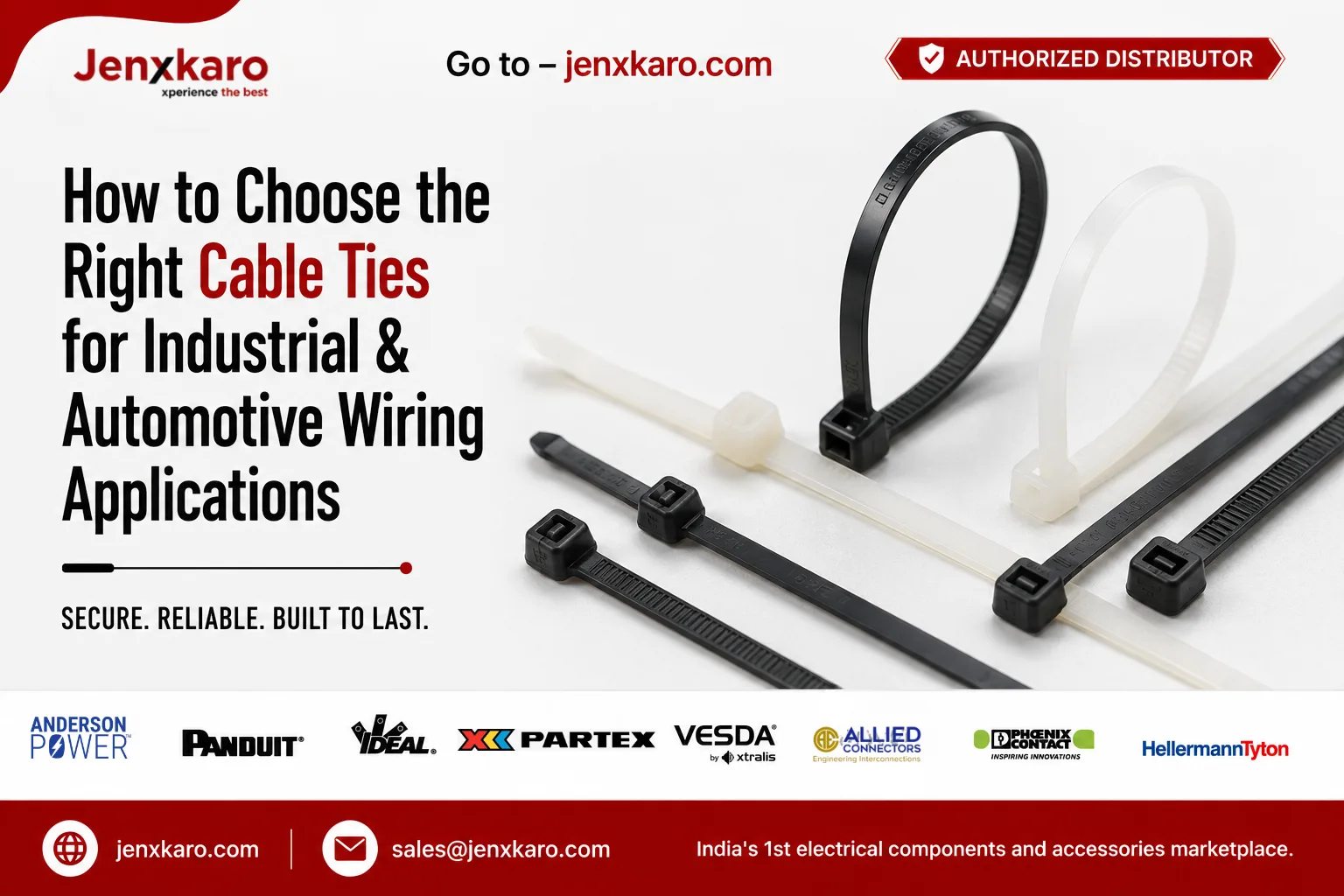
Choosing the right cable tie isn't just about size — it's about matching material, temperature rating, and mounting style to where the tie will actually live: inside a control panel, under an engine bay, or exposed outdoors. Get this wrong and you're looking at premature cracking, tie failure, or a wiring harness that comes loose under vibration. This guide walks through the factors that matter and where different tie types genuinely fit, using real part numbers as reference points — not as a product list to scroll past.
What Makes a Cable Tie "Industrial Grade"?
An industrial-grade cable tie is built to hold its tensile strength and physical integrity under conditions ordinary ties aren't rated for — sustained heat, UV exposure, vibration, or outdoor weathering. The difference usually comes down to the base material (standard nylon 6/6 vs. heat-stabilized or UV-stabilized nylon) and the tooth/locking mechanism design.
Four factors decide whether a tie is right for a given job:
- Material grade — standard nylon, heat-stabilized nylon, UV-stabilized nylon, or stainless steel
- Tensile strength — how much pull-apart force the tie can hold before failing
- Operating temperature range — critical for engine bays, industrial ovens, or outdoor enclosures
- Mounting style — standard loop, mounting-hole, or releasable/reusable designs
Standard Nylon Ties for General Wiring Bundling
For everyday panel wiring and general harness bundling where there's no unusual heat or UV exposure, a standard nylon tie is the right call — it's the most economical option that still meets UL 94V-2 flammability ratings used across most industrial wiring.
The Hellermanntyton T18R(100*2.5)BK cable tie is a compact standard-duty tie suited to light bundling inside control cabinets, while its natural (uncoloured) counterpart, the Hellermanntyton T18R(100*2.5)NATURAL cable tie, is often preferred where UV isn't a concern and colour-coding isn't needed. For tighter, lower-profile bundles — common in instrumentation panels — the Panduit PLM1M-M miniature cable tie is a better fit than a standard-size tie, simply because it doesn't leave excess bulk in cramped enclosures.
Standard-to-Heavy-Duty Ties for Load-Bearing Bundles
When a harness is thicker or carries more mechanical load — multiple cables bundled together, or ties anchoring to structural points — the tie needs higher tensile strength than a light-duty tie provides, or the bundle will loosen over time.
The Panduit PLT1M-C86 cable tie is built for exactly this — a mid-weight cable tie rated for standard industrial bundling where tensile strength matters more than compactness. Where the bundle is heavier still — thick multi-core cable runs or automotive harness trunks — the Panduit PLT4H-TL30 heavy-duty cable tie steps up to tensile ratings designed for exactly that load class.
Heat-Stabilized Ties for Engine Bays and High-Temperature Zones
Standard nylon ties become brittle and crack under sustained heat, which is why engine bays, near-exhaust wiring, and industrial equipment with heat-generating components need a heat-stabilized formulation instead.
The Hellermanntyton T30R-HSB [111-03250] heat-stabilized cable tie is formulated for continuous exposure to elevated temperatures, making it a common choice for automotive underhood wiring harnesses and industrial equipment mounted near motors or heat exchangers — locations where a standard cable tie would fail well before its expected service life.
UV-Resistant and Weatherproof Ties for Outdoor or Exposed Runs
If a cable tie sits in direct sunlight or outdoors, UV degradation — not mechanical load — is usually what causes it to fail first, so outdoor and underhood-exposed applications need UV-stabilized material even if the load itself is light.
The Hellermanntyton T50I/W (300X4.6) UV UV-resistant cable tie is built with UV-stabilized nylon specifically for this exposure, holding up where a standard black or natural cable tie would discolour and crack within a season. For applications that also need occasional access — maintenance points where a tie has to be opened and reclosed without cutting it — the Panduit PLWP1S-D weatherproof releasable cable tie serves that dual purpose: UV/weather resistance plus reusability.
| Quick Comparison | |||
| Part Number | Brand | Tie Type | Best Suited For |
| T18R(100*2.5)BK | Hellermanntyton | Standard nylon | Light panel wiring, colour-coded bundling |
| T18R(100*2.5)NATURAL | Hellermanntyton | Standard nylon | Light bundling, no UV/colour requirement |
| PLM1M-M | Panduit | Miniature | Compact harnesses, instrumentation panels |
| PLT1M-C86 | Panduit | Standard-duty | Mid-weight industrial bundling |
| PLT4H-TL30 | Panduit | Heavy-duty | Thick multi-core / automotive harness trunks |
| T30R-HSB [111-03250] | Hellermanntyton | Heat-stabilized | Engine bays, near-motor/heat-exchanger wiring |
| T50I/W (300X4.6) UV | Hellermanntyton | UV-stabilized | Outdoor or sun-exposed wiring |
| PLWP1S-D | Panduit | Weatherproof, releasable | Outdoor + reusable/reopenable access points |
Availability, Pricing & Sourcing
Jenxkaro is an authorized distributor supplying these products to customers across India, with bulk order quantities available on request.
Panduit PLM1M-M — Looking for the Panduit PLM1M-M cable tie at the best price? Find the PLM1M-M cable tie at a price starting from ₹3.26/pc on Jenxkaro. Check current availability or reach out to place a bulk order.
For the remaining products in this guide — pricing can be confirmed directly with Jenxkaro rather than stated on-page,
Stock status: Availability varies by part number and order quantity, so it's best confirmed at the time of enquiry — reach out to Jenxkaro to check current stock on a specific product rather than assuming it's in stock.
Sourcing coverage: Jenxkaro supplies these products to customers across India.
Tagged
Jenxkaro
India's 1st electrical components