


Automotive Electrical Components , Industrial Wiring Accessories
Sourcing Automotive Wire Management Components in Bulk: An Engineer's Buying Guide
Sourcing wire management components for automotive harnesses? This guide breaks down the specs, standards, and bulk-buying essentials engineers actually need — from IP-rated cable glands to vibration-proof terminal blocks.

Jenxkaro
Jul 20, 2026
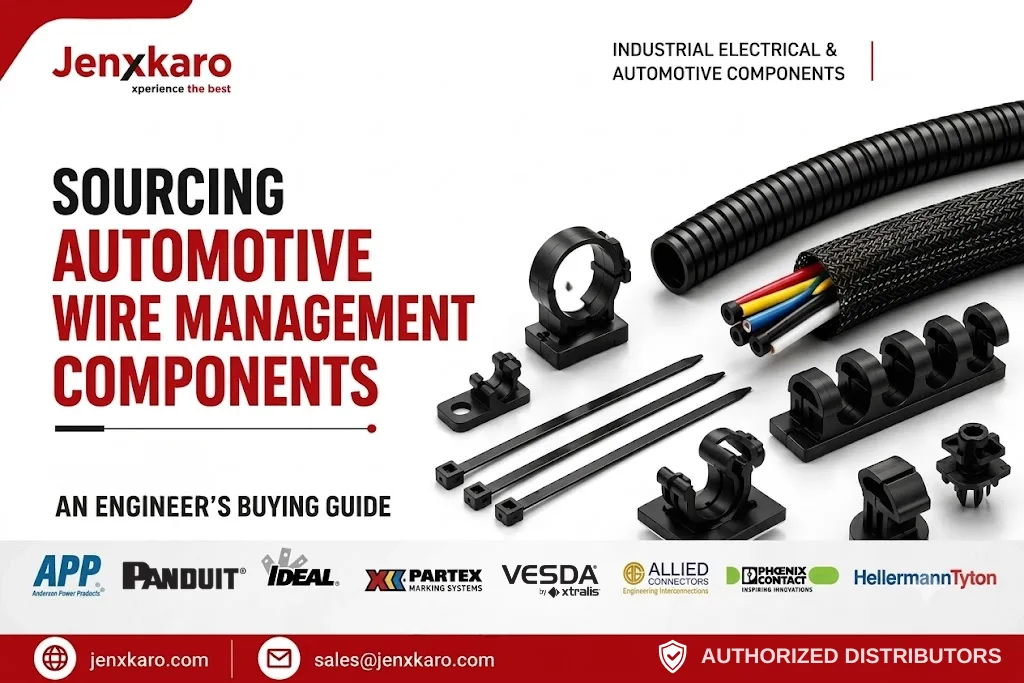
A warranty teardown rarely points back to the wire. Nine times out of ten, when a service engineer cracks open a failed harness, the conductor itself is fine — it's the gland that let moisture creep in, the clip that snapped after forty thousand thermal cycles, or the connector that lost its seal somewhere between the assembly line and the customer's driveway. If you're responsible for sourcing automotive wire management components for a production run or a fleet retrofit, this is the part of the BOM that decides whether your harness survives its warranty period or becomes a recall statistic.
This guide walks through what to specify, which standards actually matter, and how to source at volume without getting stuck behind twelve-week lead times that quietly derail a production schedule.
What Falls Under Automotive Wire Management Components?
Everything around the conductor — not the conductor itself — is what we mean by wire management. In practice, that covers seven or eight distinct product families, and most harness failures trace back to one of them:
- Cable glands, for sealed cable entry into junction boxes and control enclosures
- Sealed electrical connectors, at engine bay and chassis harness joints
- Flexible conduit pipes, protecting runs against abrasion, heat, and chemical exposure
- Automotive cable clips and routing hardware, for strain relief and secure mounting
- Identification systems — heat-shrink markers and cable tags — for circuit tracing during service
- Wire termination hardware, including lugs, ferrules, and ring terminals
- PCB terminal blocks, at ECU and control module connections
Jenxkaro carries all of these as distinct, browsable categories rather than a single generic "harness accessories" bucket, which matters more than it sounds like it should once you're trying to source eight different part types from one BOM without juggling eight different vendor catalogues.
Why a Single Weak Component Becomes a Fleet-Wide Failure
Here's the uncomfortable truth about wire management sourcing: nothing fails on the bench. An under-rated gland or a non-automotive-grade connector passes every visual inspection at receiving, gets built into the harness, and only shows its weakness months later — in salt spray, in vibration, across a full thermal cycle range. And because it's a component decision made once at BOM finalization, it fails identically across every unit built from that batch.
| Failure point | Root cause | What it costs downstream |
| Water ingress at the junction box | Cable gland IP rating mismatch | Corrosion, intermittent faults, warranty claims |
| Harness chafing against the chassis | Missing or inadequate conduit protection | Short circuits, fire risk |
| Wrong circuit serviced in the field | No identification system installed | Extended diagnostic time, comebacks |
| Connector pins loosening under vibration | Non-automotive-grade termination | Intermittent electrical faults |
| Terminal block arcing on the ECU | Under-rated PCB terminal block | Module failure, potential safety recall |
Notice the pattern: it's almost never the wire gauge that causes the problem. It's the accessory that got treated as a line-item afterthought.
Cable Glands: Getting the IP Rating Right for Automotive Environments
For anything mounted under the hood or on the chassis, the gland's IP rating isn't a nice-to-have spec — it's the difference between a sealed enclosure and a slow, invisible water leak. Engine bay applications generally call for IP68 or IP69K, since that's what actually holds up to high-pressure wash-down and the odd full submersion event during a monsoon crossing or a river ford.
Beyond the IP number, look at thread compatibility (metric M12 through M32 alongside NPT variants, depending on whether you're matching OEM or aftermarket junction box cutouts), material — nylon PA66 versus brass depending on your EMI and grounding needs — and a locking mechanism that won't back off under sustained engine-bay vibration.
Jenxkaro Hummel Cable Glands range is built around exactly this brief: IP68-rated nylon and metallic variants, thread sizes pre-matched to standard OEM cutouts, so procurement doesn't have to reverse-engineer thread compatibility from a supplier's generic catalog.
Sealed Connectors and Harness Accessories for Thermal Extremes
An automotive connector has to hold its seal from -40°C to 125°C without the material creeping or cracking, which rules out a lot of generic rubber seals that work fine in consumer electronics but were never designed for a thermal swing that wide. Silicone or Viton compounds hold up where standard rubber doesn't. Positive-lock terminal position assurance keeps pins from backing out under vibration, and gold- or tin-plated copper alloy contacts resist the corrosion that eventually causes intermittent faults nobody can reproduce on the bench.
This is the territory covered by Panduit Cable Wiring Accessories category — connector housings, seals, and TPA locks sourced specifically to these thermal and sealing tolerances, rather than pulled from a general-purpose electrical catalogue and relabeled for automotive use.
Flexible Conduit: Protecting Runs Near Heat and Moving Parts
Any harness run near the exhaust, suspension, or moving mechanical components needs mechanical protection that goes beyond a loom tape wrap. PA6 or PA12 corrugated conduit handles both chemical exposure and sustained heat far better than standard PVC options, and a split-conduit profile means a service technician can add protection to an existing harness without disassembling the whole loom — worth specifying up front if your fleet does regular retrofit work.
Jenxkaro stocks Hummel Flexible Conduit Pipes in both split and closed profiles, from 6mm up to 50mm internal diameter, including high-temperature grades sized for engine bay routing specifically.
Identification Systems: The Part Everyone Forgets Until a Recall Happens
Ask any service manager what slows down a warranty diagnosis, and traceability comes up almost immediately. A harness without printed heat-shrink sleeves or cable tags turns a ten-minute circuit check into an hour of tracing wires by hand — and that cost compounds across every unit in a fleet.
What actually matters here is fluid resistance on the printed sleeve (so the label survives contact with oil or coolant), a temperature rating that matches the harness itself, and compatibility with whatever thermal transfer or laser printer your production line already runs. Jenxkaro Identification Systems line supports both pre-printed and in-house printable formats, which tends to matter most for high-mix production lines running multiple harness variants through the same station.
Wire Termination and PCB Terminal Blocks: Where Vibration Does the Damage
Crimp quality is where a lot of automotive electrical terminal failures actually originate, and it's rarely the terminal's fault — it's usually a mismatched crimp tool or a ferrule that wasn't rated to the standard in the first place. Ferrules and ring lugs should be checked against SAE J163 or DIN 46228 crimp standards, and PCB terminal blocks — the connection point at the ECU or control module — need screw or spring-clamp termination rated for the vibration profile the vehicle will actually see, with at least 25% current headroom above nominal load.
Jenxkaro Wire Termination and PCB Terminal Blocks ranges are stocked across standard automotive gauge sizes, AWG 24 through AWG 8, specifically so a custom tooling order doesn't become the bottleneck on your production timeline.
Routing Hardware and the Tools That Determine Crimp Quality
Cable clips need to match the harness diameter and the mounting substrate — metal, plastic clip-in, or adhesive-backed — and edge protection at bulkhead pass-throughs prevents the chafing failure mode from the table above. Less obvious, but arguably more important: the crimp tools, gland wrenches, and stripping tools used on the line need to be calibrated to the specific terminal and gland specs you're using. A mismatched crimp tool is one of the most common — and most avoidable — causes of intermittent terminal failures that only show up after the vehicle's been on the road for a few months.
Jenxkaro bundles Panduit Wire Routing Accessories and Installation Tools by application, so a procurement team can order a matched set instead of reconciling specs across three separate tool vendors.
Quality Standards Worth Confirming Before You Issue a PO
Before a bulk purchase order goes out, it's worth confirming a few certifications rather than taking a datasheet's word for it:
- IATF 16949 — the automotive-specific quality management standard, effectively non-negotiable for OEM and Tier 1 supply chains
- ISO 9001 — baseline manufacturing quality management
- RoHS/REACH compliance — a standard requirement across most OEM and Tier 1 procurement policies
- UL and IP test reports — ask for the actual third-party test documentation, not just the printed claim on a spec sheet
Jenxkaro operates under IATF 16949 and ISO 9001 certified processes across the categories above, with test documentation available on request per product line.
What to Negotiate on a Bulk Order
MOQ flexibility matters more than people expect going in — tiered pricing at the 1K, 10K, and 100K breakpoints usually reveals which supplier actually has volume capacity versus which one is simply marking up a small batch. Lead time needs a real answer too: confirmed ex-stock availability versus a made-to-order timeline that only shows up after the PO is placed. A supplier willing to send a free sample kit before you commit to volume, and CAD models or datasheets before the order rather than after, is generally one worth building a relationship with. If a supplier can't produce either, that's usually the first sign the rest of the order will be a series of small surprises.
Sourcing All Eight Categories From a Single Supplier
Splitting a BOM across five or six vendors for glands, connectors, conduit, and terminals doesn't just add lead-time risk — it multiplies the compliance paperwork you have to reconcile, since each vendor's test documentation, RoHS declarations, and lot traceability come in a different format. Jenxkaro supplies all eight core categories — Cable Glands, Cable Wiring Accessories, Flexible Conduit Pipes, Identification Systems, Installation Tools, PCB Terminal Blocks, Wire Routing Accessories, and Wire Termination — under one certified quality system, which means one compliance file and one point of contact covering the entire wire management BOM.
Explore Jenxkaro complete product catalogue →
Next Steps for Engineering and Procurement Teams
Don't finalise a BOM around whatever a single vendor happens to have in stock. Validate the specs first — IP rating, thermal range, crimp standard — and then source at the volume your production schedule actually needs.
Request a Bulk Quote and Free Sample Kit → Download Technical Datasheets and CAD Models → Explore Jenxkaro Complete Product Catalog →
Jenxkaro
India's 1st electrical components
Frequently asked questions
What's the difference between a cable gland and a grommet in automotive use?
A cable gland is a sealed, mechanically locked entry point — typically IP68-rated — into an enclosure or junction box. A grommet is passive edge protection at a bulkhead pass-through; it prevents chafing but provides no sealing lock against water ingress.What IP rating do automotive wiring connectors actually need?
Under-hood and chassis-mounted connectors typically need IP67 as a floor, with IP69K required wherever high-pressure wash-down is part of the vehicle's service life — common in commercial and off-road applications.Can I get free samples before committing to a bulk order?
Yes. Reputable suppliers, Jenxkaro included, offer sample kits so engineering teams can validate fit, sealing performance, and crimp quality before a volume commitment is made.What certifications should an automotive component supplier hold, at minimum?
IATF 16949 and ISO 9001, as a floor. RoHS and REACH compliance documentation should be available on a per-SKU basis, not just at the company level.