


Metro & Rail , Technical Guide , Wire Routing Accessories , Cable Wiring Accessories
Abrasion & Vibration Protection for Metro Rail Cable Harnesses: Selecting the Right Sleeving and Clamps
Chafed jackets and loosened clamps rarely show up at commissioning — they build up quietly over years of continuous rail vibration. This guide breaks down how to specify abrasion-resistant sleeving and vibration-rated clamps together, before they become a mid-life maintenance problem.

Jenxkaro
Jul 31, 2026
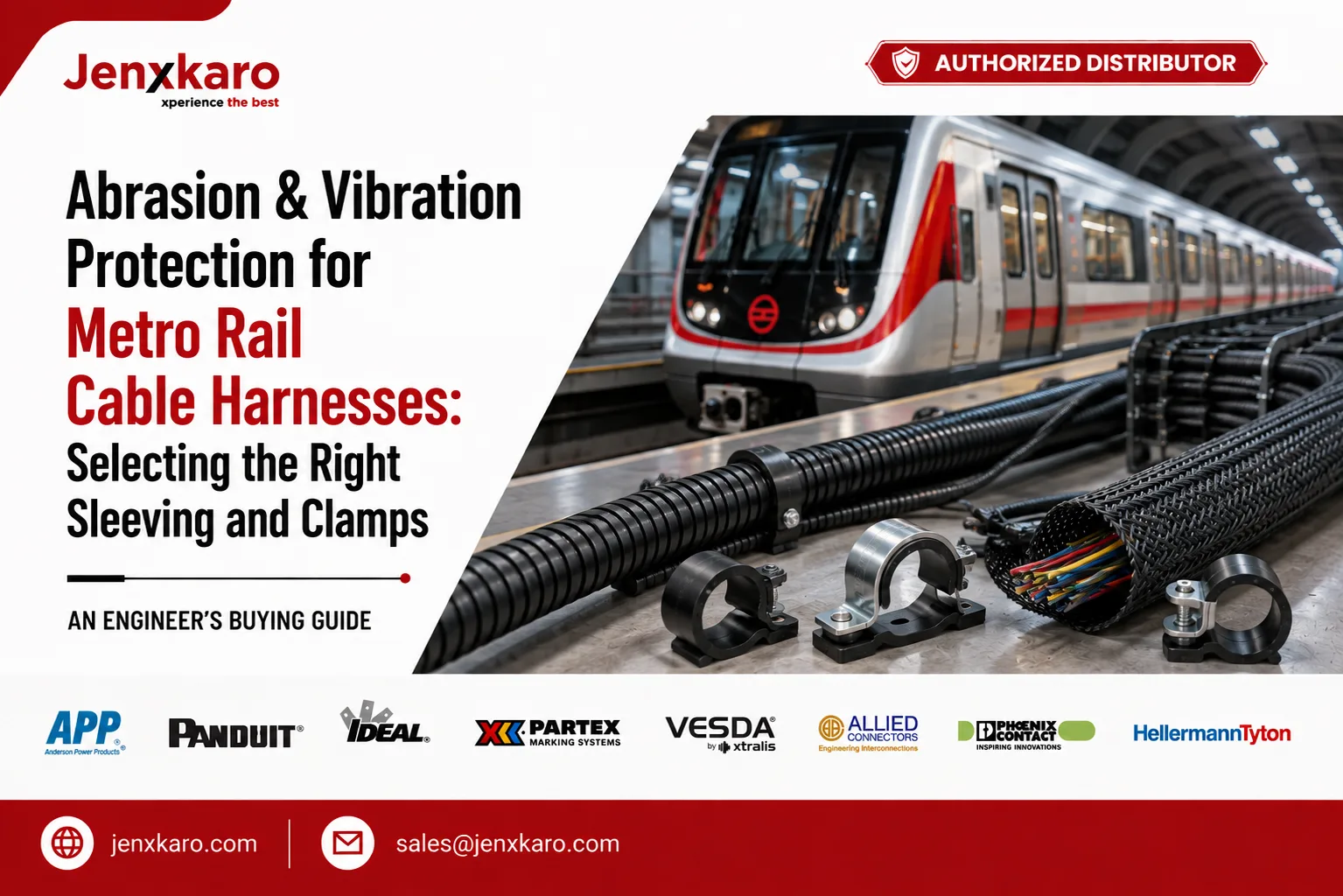
A maintenance crew inspecting an underframe cable run on a metro rail car will usually find the failure before they find the cause. A chafed jacket where a bundle rubbed against a bracket edge for two years of continuous running. A cable that's drifted an inch from where it was originally clamped, worn thin at the exact point of contact. None of this happens overnight, and none of it shows up on a commissioning inspection — it accumulates quietly, run after run, until a fault finally traces back to a harness that was never really secured against the vibration it was going to live with for the next decade.
Metro rail cable harness protection is less about picking a single tough material and more about matching two things correctly to the operating environment: the sleeving that shields the cable jacket, and the clamps that keep the whole bundle from moving in the first place. Get either one wrong and the other one's job gets a lot harder.
Why Vibration Matters as Much as Abrasion
It's tempting to treat cable protection as primarily an abrasion problem — pick a tough enough sleeve and the wear issue goes away. Rolling stock doesn't cooperate with that assumption. Continuous rail vibration, especially over long straight stretches at speed, works a cable bundle against whatever it's resting on, and it does this at a frequency and duration that a lab abrasion test doesn't always replicate well. A vibration-resistant cable clamp spaced correctly along a run does more to prevent long-term wear than upgrading the sleeving alone, because it stops the bundle from moving against its surroundings in the first place rather than just cushioning the contact once it happens. This is also why two harnesses built from identical sleeving can age completely differently depending on how well the clamping was specified — the sleeving is only ever the second line of defence.
What Actually Separates Rail-Grade Sleeving From Standard Industrial Sleeving
Standard braided sleeving handles general abrasion reasonably well in a static industrial cabinet. Rail applications ask more of it. Abrasion-resistant sleeving intended for metro and rolling stock use needs to hold up to continuous flex rather than occasional movement, needs a thermal range that covers both underframe heat exposure and tunnel-environment extremes, and — critically for passenger rail specifically — needs to meet fire, smoke, and toxicity behaviour requirements under standards like EN45545, not just a general flame-retardant claim. A sleeve that performs fine in a machine-building panel can fall short of what a rail authority's compliance documentation actually requires, which is why sourcing sleeving verified against the rail-specific standard, rather than a general industrial datasheet, matters more here than in most other applications.
Choosing Clamps for a Vibration Environment, Not Just a Mounting Point
A standard cable tie secures a bundle at a single point in time; it doesn't necessarily hold that same tension after months of continuous vibration loosens the strap incrementally. Metro rail harness runs benefit from cushioned, vibration-rated clamps spaced at intervals tight enough to prevent the bundle from sagging or swaying between mounting points — a wider gap than the application calls for is one of the more common, avoidable causes of chafe damage showing up mid-life rather than at commissioning. PANDUIT and HELLERMANNTYTON both manufacture clamp and tie ranges built specifically for continuous-vibration environments, distinct from their general industrial lines, and specifying the vibration-rated variant rather than a standard equivalent is a detail worth confirming at the procurement stage rather than assuming.
Where Sleeving and Clamps Need to Work as One System
The point where these two categories genuinely interact is at every transition — where a harness passes through a bulkhead, bends around a bracket, or exits a conduit into an open cable tray. A well-chosen sleeve does little good if the clamp two centimetres away lets the bundle shift against the sleeve's own edge; equally, a well-spaced clamp doesn't protect against abrasion if the sleeving underneath isn't rated for the contact surface it's resting against. Treating wire routing accessories as a coordinated system — sleeving selected for the thermal and compliance requirements of the run, clamps selected for the vibration profile of that specific section — prevents the gap that shows up when each component is specified in isolation by different parts of a procurement list.
Sourcing Considerations for Indian Metro Rail Projects
India's expanding metro network means most of this sourcing now happens at genuine bulk scale, across multiple rolling stock deliveries and maintenance cycles rather than a single one-off order. That makes batch consistency and compliance documentation more important than they'd be on a smaller industrial job — a sleeving batch that isn't consistently EN45545-verified across the full order quantity creates exactly the kind of hidden variance that's difficult to catch until a fault investigation years later asks for records that don't fully exist. Sourcing sleeving and clamps from an authorised distributor that can produce genuine compliance documentation and consistent batch sourcing, rather than piecing together a bill of materials from multiple unverified suppliers, is worth the extra step at the specification stage.
Building the Habit Into the Design Stage
None of this requires exotic materials or an unusual procurement process — it requires treating cable protection as part of the mechanical design of a harness run rather than a line item finalised after the routing is already fixed. Specifying rail-rated sleeving and correctly spaced, vibration-rated clamps together, verified against the same compliance standard, is what keeps a metro rail cable harness from becoming a maintenance problem five years into service instead of a design decision made once, correctly, at the outset. Engineering teams that get this right at the design stage rarely think about it again; the ones that don't end up revisiting the same harness runs during every major maintenance cycle for the life of the rolling stock.
For the specific cable ties, clamps, and abrasion protection sleeving stocked for metro and rail applications, browse Jenxkaro's Metro & Rail application range, covering Cable Wiring Accessories, Safety, and Wire Routing Accessories sourced from PANDUIT, HELLERMANNTYTON, and other established rail-compliant brands.
Tagged
Jenxkaro
India's 1st electrical components and accessories marketplace.