


EV & Battery Systems / Power Connectors
Anderson Power Products SB Connectors for EV Charging and Battery Systems in India
A connector that can't be plugged in backwards sounds like a small detail — until you're servicing a 400A battery pack under time pressure. Here's why that detail is central to EV battery design in India right now.

Jenxaro
Aug 19, 2026
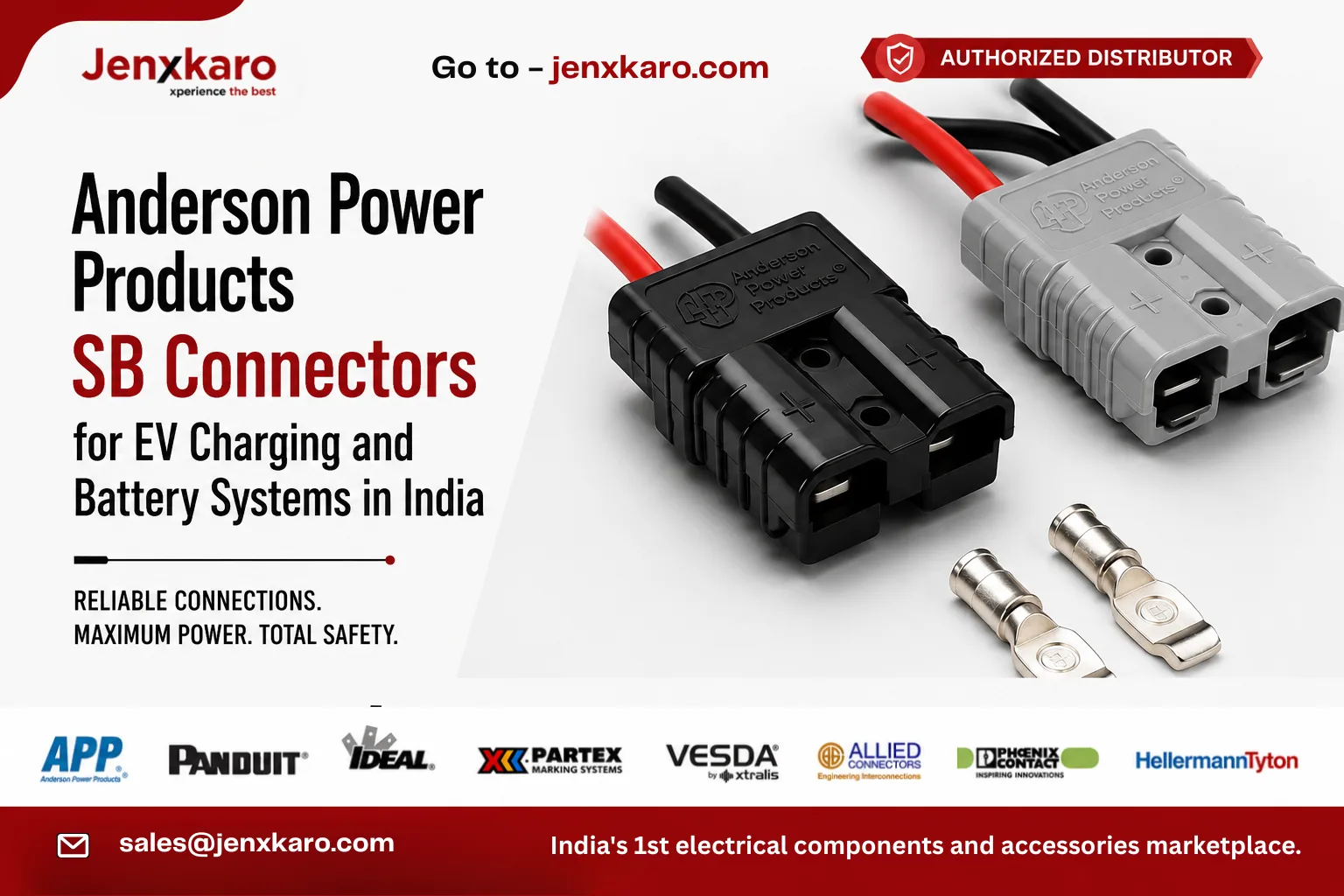
Anderson Power Products SB connectors keep showing up in a very specific kind of story technicians tell — the one where something that should have been a headache turned out fine because of a small design choice nobody outside the industry ever notices. A field engineer servicing electric forklifts described exactly that moment once: no polarity to check, no locking clip to fumble with in work gloves, just one genderless plug that physically only mates a single way. There was no room to get it wrong, which is sort of the point.
That connector was an Anderson SB series, a design that quietly became the default wherever high-current DC power needs to disconnect and reconnect without ceremony, sometimes several times a day, sometimes by someone in a hurry. And that's precisely why demand for these Anderson Power Products SB connectors is climbing across India's EV and battery storage sector right now — not because they're new, but because the problem they solve hasn't gone anywhere.
Why India's EV and Battery Boom Keeps Circling Back to SB Connectors
Here's the thing about India's battery manufacturing push: it's growing faster than most of the supporting hardware ecosystem was originally built for. Wire harness demand tied to EV production is climbing at a rate that's genuinely hard to overstate, and somewhere in that growth curve sits a fairly unglamorous but critical question — how does a battery pack, a charger, or an inverter actually connect and disconnect from high-current DC power, reliably, without needing a trained technician standing there double-checking polarity every single time?
Anderson SB connectors answer that with a genderless, color-keyed housing design. Supply and load sides use identical connector halves — there's no "male" or "female" side to get backwards — and each housing color only mates with its matching color, which physically prevents someone from cross-connecting two systems running at different voltages. For a battery pack assembler wiring multiple module interconnects, or a service centre swapping packs across different vehicle platforms on a Tuesday afternoon with three more jobs queued up, that built-in safeguard removes a failure point a standard bolted terminal was never designed to catch.
SB50-G5, SB50-G2, SB50-G3 — Picking the Right Size for the Load
The SB series isn't really one connector. It's a family, sized to whatever current the application is actually carrying, and getting that match right matters just as much as sourcing genuine hardware in the first place — a connector rated for the wrong load is a liability dressed up as a solution.
Start small: the SB50 -G2 Pin connector handles roughly 50A continuous and accepts wire gauges from around 6 AWG down to 16 AWG. That makes the Anderson SB50 -G3 Pin connector wire gauge specification relevant to smaller battery interconnects, mobility scooters, and lower-power charging setups where the current draw stays modest. Move up a size and you land on the , built for the 24–48V inverter and liftgate range — a natural fit for pallet jacks, RV power systems, and mid-size battery modules pulling more current but still within a bounded envelope. If you're specifying an Anderson SB50-G5 Pin connector for inverter and liftgate applications, this is the size that's usually doing the work.
For actual EV battery packs, though, most of the real interconnect and service-disconnect action happens one or two sizes up. The SB175 is commonly used for battery module interconnects and service disconnect points inside EV packs, and depending on contact and wire gauge configuration it can run well into the 175–280A range. Anyone researching where to buy Anderson Power connector for EV batteries in India is usually already deep into an EV pack design and has hit the point where a standard bolted lug just isn't practical anymore. Beyond that sits the SB350, rated up to 350A and still the industry standard for electric forklift battery connections — a use case Anderson connectors have quietly owned for decades, long before anyone was thinking about EVs at all. Across all four sizes, contacts are silver-plated to keep contact resistance low, and the housings carry UL recognition under Underwriters Laboratories' Component Program, which starts to matter a great deal once a battery system's overall safety case depends on every single connection point behaving exactly as specified.
The Crimp Matters as Much as the Connector
Here's something that gets glossed over more often than it should: a genuine SB connector only performs to its rated spec if the crimp termination was actually done right. Anderson's own documentation is specific about this, right down to which tooling to use for which contact size — hand tools for lower-volume runs, pneumatic cycle-controlled tooling once you're producing at scale. Skip that step, or improvise with the wrong tool, and you introduce exactly the kind of resistance and heat buildup a high-current connector exists to avoid in the first place. For a genderless DC power connector for EV charging India applications, that means installation tooling isn't some minor line on a bill of materials — it's directly tied to whether the finished connector delivers the current rating printed on its own datasheet, or quietly underperforms it.
Not Just EVs — Where Else These Connectors Turn Up
EV battery packs and charging systems are the fastest-growing use case right now, sure, but SB connectors were never limited to that world. Solar and battery storage installations lean on them for battery-to-inverter connections in much the same way, and industrial equipment — electric forklifts, golf carts, neighbourhood electric vehicles — has relied on the same underlying SB platform for years, largely because the design simply hasn't needed to change. That's part of why engineers spec'ing connectors for a brand-new EV program in India often default to a platform that's already proven itself somewhere adjacent. It's not romantic, but it's dependable, and dependable tends to win in electrical design.
Why Sourcing Actually Matters Here
Battery interconnect hardware isn't really a place to gamble on where it came from. A connector that can't hold its rated current under sustained load, or a housing that doesn't key correctly against a mismatched voltage system, turns what looked like a minor procurement shortcut into a genuine safety incident — and those incidents tend to happen at the worst possible moment, not during a calm bench test. Working with an APP connector distributor in India teams can actually verify matters more than it might seem on paper.
Jenxkaro, powered by Jainsons India Pvt. Ltd., supplies genuine Anderson Power Products connectors as part of its Cable Wiring Accessories and Wire Termination range, alongside the crimp tooling needed to terminate them correctly. That means EV and battery system assemblers get one verified source for both the connector and the hardware it depends on, rather than piecing together a supply chain from wherever a part happens to show up cheapest that week.
If you're sourcing SB connectors or crimp tooling for an EV battery, charging, or industrial power project in India, Jenxkaro's Anderson Power Products range is available through the Cable Wiring Accessories and Wire Termination categories — reach out to sales@jenxkaro.com for datasheets, part availability, and bulk pricing.
Tagged
Jenxaro
India's 1st electrical components
Frequently asked questions
What is an Anderson SB connector used for?
Anderson SB connectors are heavy-duty, genderless DC power connectors used for battery interconnects, service disconnects, and high-current charging connections in EVs, forklifts, solar storage systems, and industrial equipment.What's the difference between SB50, SB120, SB175, and SB350 connectors?
They're sized for different current loads. SB50 handles roughly 50A, SB120 suits 24–48V inverter and liftgate applications, SB175 is commonly used in EV battery pack interconnects up to around 280A, and SB350 is rated up to 350A and remains the standard for electric forklift battery connections.Why are Anderson connectors color-keyed?
Color keying ensures a connector housing only mates with another housing of the same color, which prevents accidental cross-connection between systems running at different voltages — a real safety consideration in multi-voltage battery installations.Does the crimp tool actually affect connector performance?
Yes. Anderson specifies particular crimp tooling for each contact size, and an inconsistent or improvised crimp introduces resistance and heat that can cause a connector to underperform its rated current, even if the connector itself is genuine.Where can I buy genuine Anderson Power Products connectors in India?
Jenxkaro, powered by Jainsons India Pvt. Ltd., supplies genuine Anderson Power Products SB connectors and crimp termination tooling as part of its Cable Wiring Accessories and Wire Termination product range.