


Data Centre Infrastructure , Cable Management
Heavy-Duty Cable Cleats for Data Centres: What Engineers Should Know
A short circuit doesn't ask permission — it just happens. Here's why heavy-duty cable cleats are the one piece of data centre cable management engineers can't afford to under-spec.

Jenxkaro
Aug 11, 2026
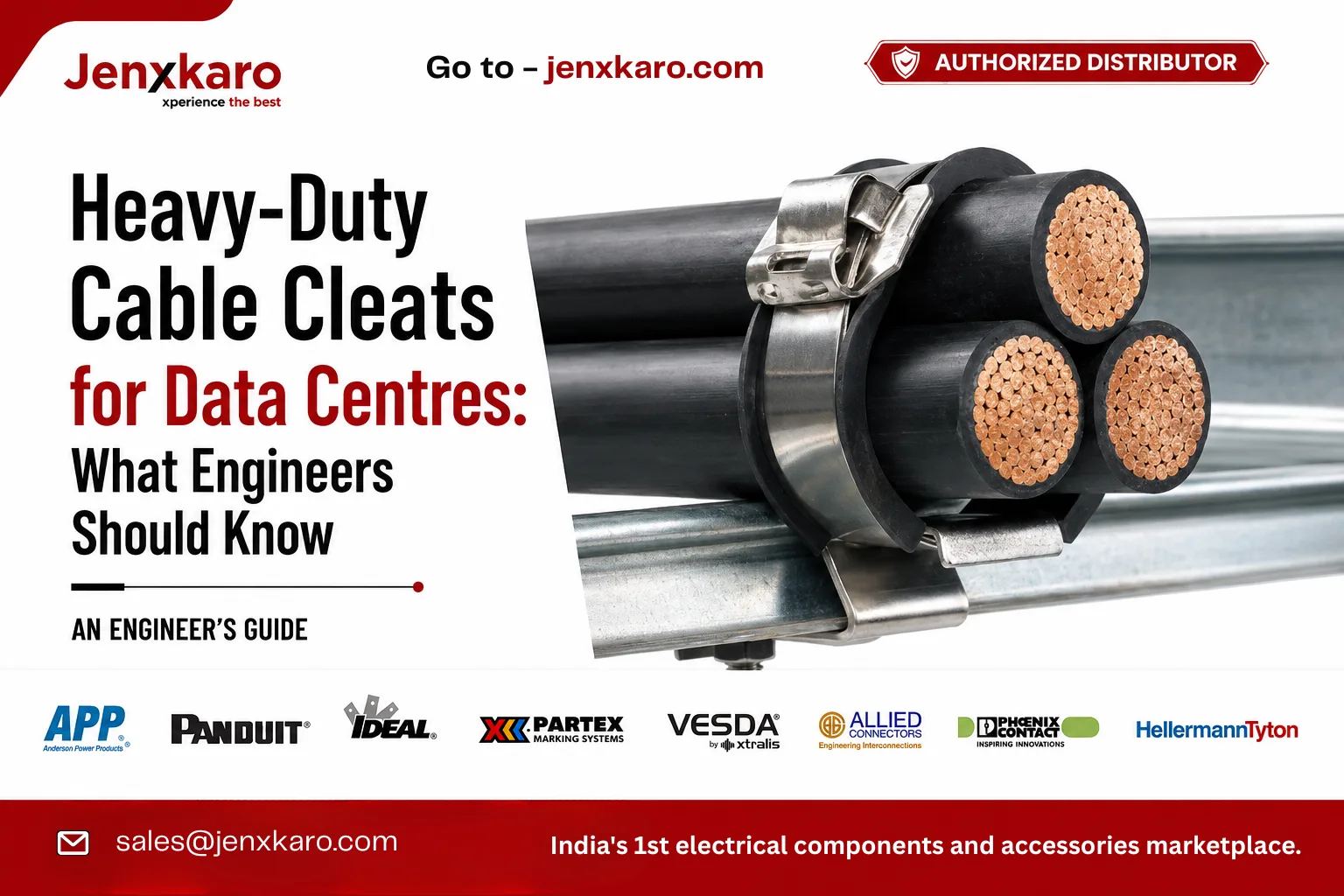
An electrical contractor once told us he'd never lost sleep over a cable tie — but a cable cleat spec, gotten wrong on a 33kV feeder run, kept him up for a week. That's the real difference between routine cabling work and the kind of restraint a data centre actually needs once power densities climb past what a nylon tie was ever built to handle.
What Are Heavy-Duty Cable Cleats, and Why Do Data Centres Need Them?
Heavy-duty cable cleats are engineered restraint devices that secure power cables to trays, ladders, struts, rails, or beams. Unlike standard cable ties, their job isn't tidiness — it's holding a conductor in place when a short circuit hits. During a fault, the electromagnetic forces between parallel power cables can be violent enough to fling cables off a tray, snap terminations, or trigger a cascading failure across adjacent circuits. A properly rated cleat absorbs that force instead of letting the cable move.
This distinction matters more in 2026 than it did five years ago. AI-driven workloads have pushed rack densities into territory where LV and MV power runs sit in tighter bundles, on more crowded ladder trays, carrying more current per metre than most legacy data centre designs anticipated. What used to be a secondary line item in an electrical BOQ is now, in many high-density builds, a load-bearing safety decision.
Two Pan-Steel® products from Jenxkaro's PANDUIT range show what this restraint hardware looks like in practice:
Pan-Steel® PCSLSH-B-CR Cable Cleat Cushion Sleeve, Reel, TPE Low Smoke-Halogen Free, 100ft L PCSLSH-B-CR The PCSLSH-B-CR Custom Length Cushion Sleeving is designed for use with metal locking strap and buckle strap cable cleats to help protect in the event of a short circuit fault, minimizing disruption and damage to personnel and property. The cushion sleeving is compatible with heavy or super-heavy cross section ties, custom length banding systems, or MS strapping, for use in harsh environments and applications. Features U-shaped channel, black LSHF TPE material, 26.8mm width, and 100-foot reels.
Pan-Steel® MLT4DSH-Q316 Cable Cleat, MLT Strap, 316 SS, Single/Trefoil/Quad MLT4DSH-Q316 The MLT4DSH-Q316 self-locking cable cleat speeds up installation with a unique self-locking head that secures into any position along the band's length. The smooth and safe cable banding passes through the head twice, providing additional strength in short circuit applications. The variable design is compatible with quad, trefoil, and multicore cables and certified to IEC61914:2015, tested up to 75.1kA peak fault current. Features 316 AISI SS, 5340N tensile strength, 102mm bundle capacity.
The IEC 61914 Standard: Why Certification Isn't Optional
Engineers specifying restraint hardware for high-density facilities generally look for cleats tested against IEC 61914, the standard that verifies a cleat's ability to withstand short-circuit electromechanical forces without loosening, cracking, or letting the cable creep out of position. A cable cleat that isn't rated to this standard is essentially unverified hardware sitting on a live power path — not something most data centre operators are willing to gamble on during a fault event.
Certification testing under IEC 61914 typically evaluates a cleat under simulated fault-current conditions across a range of conductor diameters and cable configurations — single-core, trefoil, and multi-core arrangements all behave differently under electromechanical stress, and a cleat validated for one configuration isn't automatically suitable for another. This is one reason experienced engineers ask distributors for the actual test report rather than relying on a datasheet claim alone.
Choosing the Right Cable Cleat Material
Material selection plays a direct role in performance. Polymer cleats generally suit lighter LV runs where flexibility and cost matter more than raw mechanical strength — they're common in office-adjacent or lower-risk white-space zones. Stainless steel and aluminium variants get specified where corrosion resistance, higher fault-current ratings, or exposure to harsher grey-space environments come into play, particularly around generator rooms, switchgear areas, or outdoor plant where humidity and temperature swings are harder on hardware over time.
The right choice depends on conductor size, expected fault current, tray type, and the environmental conditions inside that specific data hall. A cleat that performs well in a climate-controlled white space can behave very differently after eighteen months in a humid grey-space corridor, which is why material selection deserves the same scrutiny as the fault rating itself. A 316-grade stainless option like the MLT4DSH-Q316 is built specifically for that kind of demanding, corrosion-prone environment rather than a controlled white-space run.
Cable Cleat Spacing and Sizing: Getting the Calculation Right
One of the more overlooked parts of a cable cleat specification is spacing — how far apart cleats need to sit along a tray run to keep the restraint effective. Spacing that's too wide leaves gaps where a cable can still whip or flex under fault conditions; spacing that's too tight adds unnecessary material cost and installation time without a proportional safety benefit. This calculation depends on conductor diameter, expected short-circuit current, and the specific cleat's tested rating — it isn't a fixed number that applies uniformly across every project, which is why pulling the manufacturer's engineering data for the exact cleat model matters more than working from a rule of thumb.
Getting this wrong doesn't usually show up during commissioning. It shows up months or years later, during an actual fault event, when the gap in the restraint system is the difference between a contained incident and a cascading one.
Installation Sequencing: Pre-Staged vs Post-Pull Cleats
Traditional cable cleats are installed before the cable pull begins, which means installers have to predict exact cleat locations and mount the hardware in advance. In dense tray environments — the kind now common in AI-driven data centre builds — that pre-staged hardware can interfere with rollers during the pull itself, adding friction and tension exactly where large-diameter conductors can least afford it. Once the cables are in, crews then have to work around heavy conductors in a confined tray to fasten the remaining cleats, which slows the job and increases the physical strain on installation teams.
Post-pull cleat systems, which allow the restraint hardware to be fitted after the cable run is complete, are increasingly preferred in high-density projects for exactly this reason. They reduce friction during the pull, improve access for installers working in already-crowded trays, and shorten the overall installation window without compromising the fault-current performance once the cleats are in place. For engineers managing tight commissioning schedules, this sequencing decision can matter almost as much as the cleat's material or rating.
Cable Cleats and Fire Safety in Data Centre Design
Cable cleats aren't purely a short-circuit consideration — they also play a role in overall fire safety and containment. Loose or poorly restrained cabling in a tray is more prone to chafing against adjacent conductors or sharp tray edges over time, and a compromised insulation jacket in a high-current power run is a real ignition risk in a facility where downtime and safety margins are both non-negotiable. Regulations in most jurisdictions require secure cable installation specifically to reduce this kind of risk, and a properly cleated tray run is a meaningful part of meeting that requirement, not just a mechanical nicety.
A Quick Checklist Before You Finalise a Cable Cleat Spec
Before locking in a cable cleat order for a data centre build, it's worth confirming the fault-current rating matches the actual short-circuit study for that section of the electrical system, the material is appropriate for the specific white-space or gray-space environment it's going into, the spacing calculation has been run against the manufacturer's tested data rather than an approximate figure, and the cleat's IEC 61914 certification covers the conductor configuration actually being installed — single-core runs and trefoil bundles are not interchangeable from a testing standpoint. Skipping any one of these checks is how a project ends up with hardware that looks correct on paper but underperforms in the field.
Where PANDUIT Cable Cleats Fit Into a Data Centre Build
This is where PANDUIT's cable cleat range fits into a Jenxkaro-supplied project. As an Authorised PANDUIT Distributor, Jenxkaro sources the same cleats engineers already trust for structured cabling and cable management across enterprise and hyperscale facilities — designed for strut, ladder tray, and beam mounting, and validated for the short-circuit conditions IEC 61914 is built around. For engineers doing the actual take-off — sizing conductor diameters, calculating spacing intervals, or matching cleat material to a fire-rated gray-space zone — that's the difference between a component that's merely present on the tray and one that's actually doing its job when a fault occurs.
If you're speccing cable cleats, cable ties, or broader cable management hardware for a data centre build, Jenxkaro's PANDUIT catalogue covers the full restraint and containment range — reach out to sales@jenxkaro.com or browse the PANDUIT product line at jenxkaro.com for datasheets and bulk pricing.
Jenxkaro
India's 1st electrical components and accessories marketplace.
Frequently asked questions
What is the purpose of a cable cleat in a data centre?
A cable cleat restrains power cables against the mechanical forces generated during a short circuit, preventing cable movement, damage, or fault escalation.Is IEC 61914 mandatory for data centre cable cleats?
It isn't universally mandated by law, but it's the internationally recognised benchmark most data centre operators and consultants specify to prove short-circuit restraint performance.What material should I choose for high-density data centre cleats?
Stainless steel or aluminium cleats are typically specified for high fault-current, high-corrosion-risk zones, while polymer cleats suit lighter, lower-risk LV runs.How far apart should cable cleats be spaced on a tray?
Spacing depends on conductor diameter, expected fault current, and the specific cleat's tested rating — it should be calculated from the manufacturer's engineering data rather than assumed.Should cable cleats be installed before or after the cable pull?
Post-pull cleat systems are increasingly preferred in high-density trays, since pre-staged cleats can interfere with rollers and slow down the pull itself.Where can I buy genuine PANDUIT cable cleats in India?
Jenxkaro, powered by Jainsons India Pvt. Ltd., is an authorised PANDUIT distributor supplying genuine cable cleats, cable ties, and cable management hardware for data centre projects, including the Pan-Steel® MLT4DSH-Q316 cable cleat and the PCSLSH-B-CR cushion sleeve.