


Aerospace & Defence , Cable Wiring Accessories
Ruggedized Wiring Components for the Defence and Drone Industry: A Complete Selection Guide
From MIL-SPEC cable ties to IP68-rated glands — this guide breaks down exactly which ruggedized wiring components defence and drone manufacturers should be specifying. A no-guesswork selection guide for engineers building for extreme environments.

Jenxkaro
Jul 27, 2026
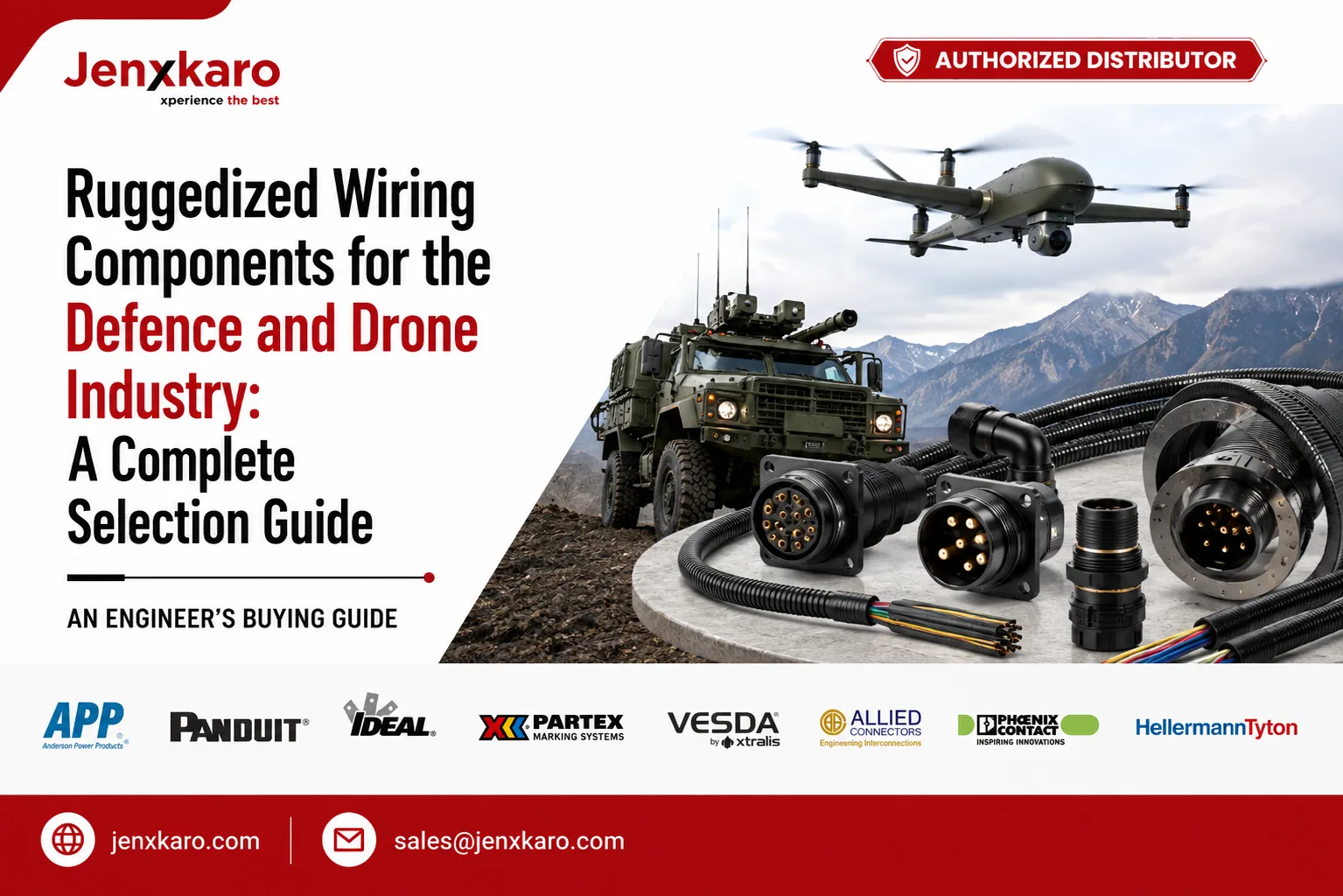
A UAV flying a surveillance route at altitude doesn't get the luxury of a service call when a connector loosens mid-flight. Neither does a military vehicle running through a dust storm with a wiring harness that was specced for an office environment rather than a battlefield. This is the gap that separates commercial-grade electrical components from Ruggedized Wiring Components — the second category is built for the assumption that failure isn't an option, not a possibility to plan around later.
Engineers designing for defence and drone platforms know this instinctively, but procurement decisions don't always reflect it. A wiring harness that passes a bench test in a controlled lab can still fail in the field if the underlying components — glands, connectors, ties, sleeves — weren't chosen with the actual operating environment in mind. This guide walks through what actually matters when specifying Defence Wiring Components and Drone Wiring Components for platforms that have to work the first time, every time.
Why Ruggedized Wiring Components Matter in Defence and Drone Applications
Defence and aerospace electronics operate under conditions that would retire most commercial equipment within months. Vibration from rotor systems, thermal cycling between high-altitude cold and ground-level heat, exposure to fuel vapours, and constant mechanical stress from vehicle movement all act on the same wiring harness simultaneously. A component that handles one of these stresses well but not the others tends to fail exactly when it's needed most — mid-mission, not during a scheduled inspection.
This is why Aerospace Wiring Components and defence-grade electrical accessories are specified to entirely different tolerances than standard industrial parts. The margin for error shrinks considerably when a wiring fault means loss of a UAV, a communications blackout, or a vehicle system going dark in the field.
Environmental Challenges Faced by Military and UAV Wiring Systems
Vibration is probably the most persistent challenge across both platforms. A drone's motor vibration or a vehicle's engine and terrain-induced shock will work standard cable ties loose within weeks, which is exactly why heavy-duty and stainless steel cable ties, along with properly rated mounting bases, are non-negotiable in these builds rather than a nice-to-have upgrade.
Moisture and dust ingress present a second recurring problem, particularly for platforms operating outdoors or in desert and coastal environments. This is where IP68-rated cable glands and EMC cable glands earn their place — sealing cable entry points against both environmental ingress and electromagnetic interference, which matters enormously in systems where signal integrity is mission-critical.
Thermal extremes and chemical exposure round out the list. UV-resistant accessories prevent the slow degradation that standard nylon components suffer under sustained sun exposure, and corrosion-resistant components matter wherever a platform will see salt air, fuel vapour, or de-icing fluid over its service life. None of these are edge cases in defence and drone deployment — they're the baseline operating environment.
Essential Ruggedized Wiring Components Every Engineer Should Consider
A properly specified harness for this category draws from a fairly consistent component set, though the exact mix shifts depending on the platform. Cable routing inside a control panel or vehicle chassis typically relies on cable ties and cable clamps rated for the vibration profile involved. Cable protection along exposed runs comes down to flexible conduit, braided sleeves, and heat shrink tubing, each suited to a different combination of abrasion, heat, and flex requirements.
Secure cable entry into sealed enclosures is where metal cable glands and EMC cable glands do their work, and reliable electrical connections — particularly in high-vibration platforms — depend on cable connectors and industrial connectors rated for repeated mate-unmate cycles without contact degradation. Wire identification rounds out the list: wire markers and cable markers that hold up under field conditions save significant time during maintenance and fault-finding on platforms where downtime has operational consequences, not just cost implications.
Together, these categories form what's really meant by Cable Wiring Accessories for defence-grade builds — not a single product, but a coordinated system where each component supports the reliability of the others.
How to Select the Right Cable Management and Protection Products
Selection starts with the actual operating envelope, not a generic spec sheet. A component rated for indoor industrial use and one rated for continuous outdoor exposure on a UAV airframe are not interchangeable, even if their base material looks similar on paper. Engineers evaluating Cable Management Solutions for UAVs need to check vibration rating, temperature range, IP rating, and material compatibility against the platform's actual mission profile — not just its nominal spec.
Weight matters more in drone applications than almost anywhere else in industrial wiring, since every gram of harness and gland adds up against payload capacity. This makes material selection — aluminium versus brass glands, for instance — a genuine engineering tradeoff rather than a cosmetic choice. For ground vehicles and fixed installations, weight matters less than mechanical robustness and resistance to repeated flexing.
Common Procurement Mistakes to Avoid
The most common mistake in this category is treating ruggedized components as a drop-in replacement for standard industrial parts, buying based on price parity rather than actual environmental rating. A cable gland that looks identical to an IP68-rated unit but lacks the certification will pass a visual inspection and fail in the field, often at the worst possible moment.
Batch inconsistency is the second recurring issue — sourcing Ruggedized Cable Management Components India teams can rely on means every unit in a production run meets the same tensile, thermal, and ingress specifications, not just the first sample tested. And skipping documentation is a mistake that surfaces later: defence and aerospace procurement almost always requires traceable certification, and a supplier who can't produce it at the time of order is a liability during audit, not just an inconvenience.
Why Global Brands Deliver Better Long-Term Reliability
Brands like PANDUIT, HELLERMANNTYTON, ANDERSON POWER PRODUCTS, KLAUKE, LAPP, PARTEX, and WEIDMÜLLER have built their reputations on components that meet exactly these defence and aerospace tolerances, tested and certified rather than assumed. Working with globally recognized manufacturers reduces the risk of inconsistent quality across a production run, and it means a spec sheet actually reflects what arrives in the box — which matters enormously when a component is going into a platform that can't be easily serviced once deployed.
Why Engineers Choose Jenxkaro for Industrial Wiring Components
Jenxkaro supplies defence equipment manufacturers, drone OEMs, and aerospace integrators with genuine components from PANDUIT, HELLERMANNTYTON, ANDERSON POWER PRODUCTS, PARTEX, sourced with the certification and batch consistency these applications require. For engineering teams building platforms where a wiring failure isn't a minor fault but an operational risk, that combination of authenticity, technical documentation, and stock depth across brands is what makes the sourcing decision straightforward rather than a recurring gamble.
Conclusion
Ruggedized wiring components aren't a premium add-on for defence and drone platforms — they're the baseline requirement for systems that have to perform under conditions standard industrial parts were never designed for. Getting the selection right, from cable glands to connectors to identification systems, is what separates a platform that performs reliably in the field from one that generates unplanned maintenance and mission risk.
Building a defence, drone, or aerospace platform and need ruggedized wiring components you can specify with confidence? Get in touch with Jenxkaro for genuine, certified components from PANDUIT, HELLERMANNTYTON, ANDERSON POWER PRODUCTS, PARTEX & MORE.
Jenxkaro
India's 1st electrical components and accessories marketplace.