


Cable Wiring Accessories , Aerospace & Defence
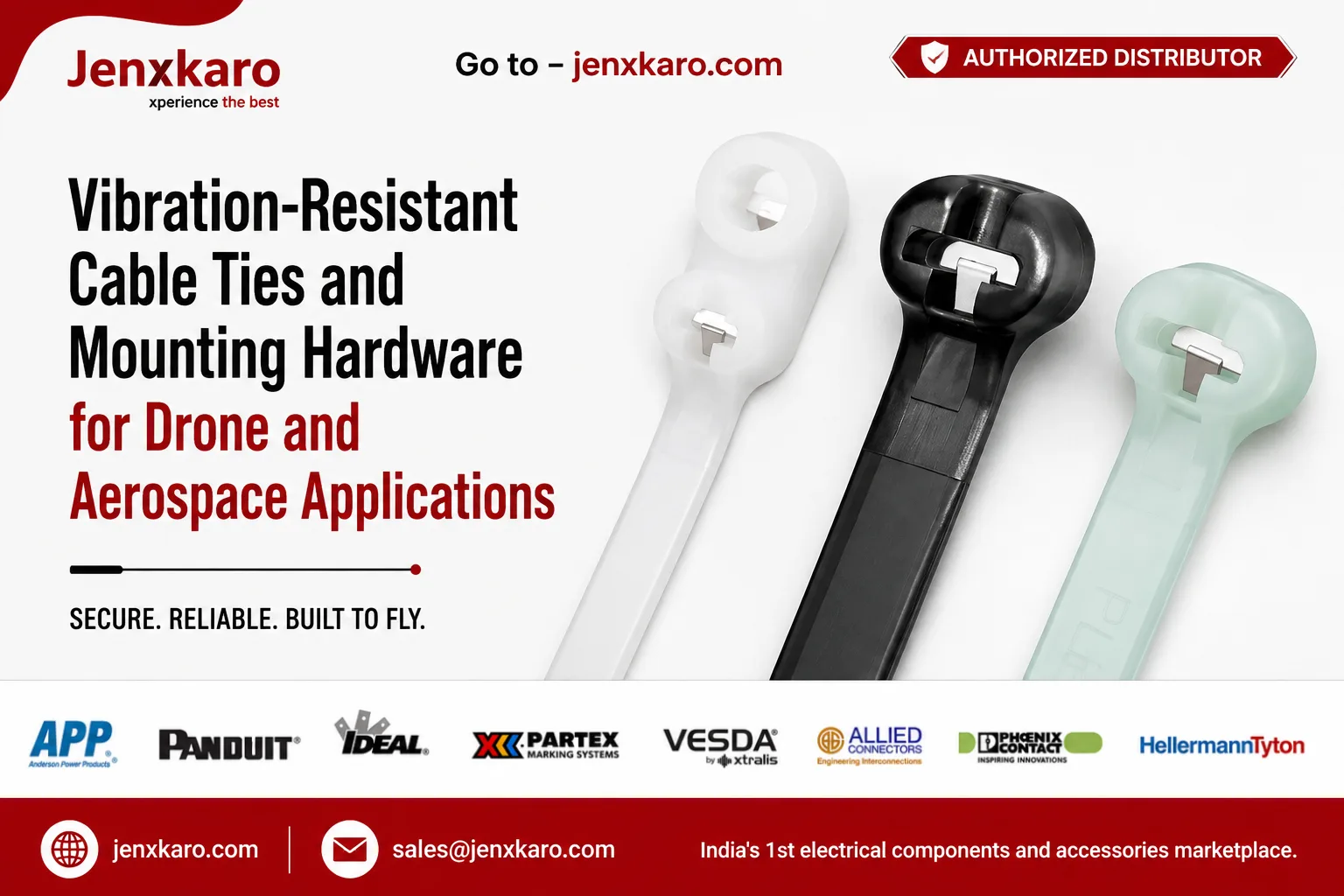
Vibration-Resistant Cable Ties and Mounting Hardware for Drone and Aerospace Applications
A cable tie that holds fine on a workbench can still fail mid-flight. Here's why standard nylon doesn't survive what a drone actually puts it through.

Jenxkaro
Aug 26, 2026
Somewhere in the wreckage report of more than one failed UAV test flight, an investigator has written some version of the same sentence: a cable came loose, made contact with something it shouldn't have, and the flight controller lost a signal it needed. Nobody designed that failure on purpose. It usually traces back to a cable tie that was never meant to sit through what a drone airframe actually does to it — thousands of vibration cycles, wide temperature swings, and enough flex to slowly work a standard fastener loose without anyone noticing until it's too late. That's the real case for vibration-resistant cable ties for drones, and it's a narrower, more specific problem than general "ruggedized wiring" advice tends to cover.
Why Standard Nylon Ties Aren't Built for This
A typical nylon cable tie does its job fine in a server room or an electrical panel — static conditions, a controlled temperature range, minimal ongoing stress. A UAV airframe is nothing like that. Rotor vibration runs continuously through every structural mounting point on the aircraft, and standard Nylon 6 or lower-grade nylon compounds lose tensile strength surprisingly fast under that kind of sustained cyclic load. Add in thermal cycling — a drone that sits on tarmac in direct sun one hour and climbs to altitude in far colder air the next — and the plastic itself starts to behave differently than it did in a lab test at room temperature.
This is where thermal cycling cable tie failure actually shows up in the field. It's rarely a dramatic snap. More often, a tie gradually loosens as the material relaxes and contracts through repeated heat-cool cycles, until the tension holding a harness in place simply isn't there anymore. By the time that's visible during a pre-flight check, the tie has usually already failed its actual job for a while.
What Makes Aerospace-Rated Ties Different
The material composition is where the real difference starts. Nylon 66, rather than Nylon 6, is the baseline most aerospace and demanding industrial applications specify, largely because it retains tensile strength more consistently down to lower installation temperatures and holds up better under sustained mechanical stress. Some aerospace-grade ties go further still, using PEEK — a high-performance polymer that's become common in aerospace and defence specifically because of its chemical resistance and stability across a wide temperature range, well beyond what standard nylon can handle without degrading.
For genuinely extreme environments — high vibration paired with extreme heat, chemical exposure, or long-term outdoor UV exposure — stainless steel ties move into the picture entirely. HellermannTyton stainless steel range, for instance, is rated to withstand continuous exposure up to roughly 538°C and is built specifically to resist vibration, radiation, weathering, and chemical exposure over a genuinely long service life, not just a warranty period. That's a very different performance profile from a nylon tie that starts to lose integrity well below flight-relevant temperature extremes.
Tensile strength retention Panduit cable ties is really the metric that matters most here, more than the tie's rated breaking strength on day one. A cable tie that tests at 50 lbs new but retains only a fraction of that after a hundred thermal cycles isn't actually a 50 lb tie in service — it's whatever strength survives the environment, and that number is what should be driving the specification, not the datasheet figure alone.
Mounting Bases: The Other Half of the Equation
A cable tie is only as reliable as what it's anchored to, and mounting base selection matters just as much as tie material on a UAV airframe where weight and structural integrity both carry real constraints. Adhesive-backed mounting bases work well on lightweight composite or aluminium surfaces where drilling isn't practical or would compromise structural strength, but adhesive performance itself varies significantly with temperature and vibration exposure — a base rated for indoor electrical panel use isn't automatically suitable for an airframe exterior.
Screw-fix mounting bases offer a more mechanically secure anchor point where the airframe structure allows for it, which matters particularly for UAV wiring harness Panduit Mounting Bases hardware running through higher-vibration zones near rotors or motor mounts. The right choice generally comes down to the specific mounting surface, the vibration profile at that exact point on the airframe, and how much weight budget is actually available — a screw-fix base adds a small amount of mass and structural penetration that an adhesive base avoids, but trades that for a meaningfully more secure hold in the zones where it matters most.
Standards and Specification: What to Actually Look For
Most aerospace-grade cable ties carry a MIL-SPEC or SAE designation tied to size, material, and tensile strength — SAE-AS33671 is a commonly referenced standard in this space. Specifying to a recognized standard rather than a generic "heavy-duty" label matters because it gives an engineer a verifiable performance baseline rather than a marketing claim, particularly important when a MIL-SPEC cable tie material choice is being made for a component that's genuinely difficult and expensive to access for maintenance once it's integrated into a flying airframe or a satellite bus. PANDUIT's IMLT102H-L Stainless Steel Cable Tie is a concrete example of hardware built for exactly this level of demand — a metal tie rather than a polymer one, suited to the highest vibration, temperature, and long-term exposure conditions a UAV or satellite harness can face, and the kind of part number an engineer should be asking a supplier for by name rather than accepting a generic "mil-spec equivalent" substitute.
It's also worth understanding how tensile ratings are actually tested. Manufacturers typically publish figures based on either a pull test or a loop test, and the two measure genuinely different things — a pull test evaluates straight-line breaking strength, while a loop test better reflects how a tie performs once it's actually wrapped around a bundle under real mechanical load. For UAV and satellite harness applications specifically, loop test data tends to be the more relevant number, since that's closer to how the tie is actually loaded in service.
Satellite Bus Harnessing: A Related but Distinct Challenge
Everything above applies just as directly to satellite bus harnessing, though the specific stress profile differs from a UAV. A satellite doesn't deal with rotor vibration in the same continuous way, but it does face extreme thermal cycling between direct solar exposure and deep shadow, combined with the reality that once a harness is integrated and the spacecraft is launched, there is no field-service option if a tie fails. That makes long-term tensile retention and material stability under thermal extremes arguably even more critical in a space application than in a UAV, where at least a failed component is theoretically accessible for a ground-based fix.
Sourcing Genuine PANDUIT and HELLERMANNTYTON Hardware
Specification only matters if the hardware installed actually matches what was specified, which is why sourcing genuine components isn't a minor procurement detail in aerospace and drone applications. Jenxkaro, powered by Jainsons India Pvt. Ltd., supplies genuine PANDUIT stainless steel cable ties and HELLERMANNTYTON aerospace ties, along with the mounting base hardware to anchor them correctly, as part of its Cable Wiring Accessories range — giving UAV manufacturers and aerospace integrators a verified source for both the tie material and the anchor point it depends on.
If you're specifying cable ties or mounting hardware for a UAV, satellite, or aerospace wiring harness project in India, Jenxkaro's PANDUIT and HELLERMANNTYTON range is available through the Cable Wiring Accessories category — reach out to sales@jenxkaro.com for datasheets, MIL-SPEC verification, and bulk pricing.
Tagged
Jenxkaro
India's 1st electrical components
Frequently asked questions
Why do standard nylon cable ties fail on drones?
Standard nylon cable ties lose tensile strength under sustained vibration and thermal cycling, which are continuous conditions on a UAV airframe but rare in typical indoor electrical applications the ties were originally designed for.What material is best for vibration-resistant cable ties in aerospace applications?
Nylon 66 is the common baseline for better tensile retention at low temperatures, PEEK is used for extreme chemical and thermal resistance, and stainless steel ties are specified for the most demanding vibration, heat, and long-term exposure conditions.What's the difference between a pull test and a loop test for cable ties?
A pull test measures straight-line breaking strength, while a loop test measures performance when the tie is wrapped around a bundle under load — loop test data is generally more representative of real UAV harness conditions.Should I use adhesive or screw-fix mounting bases on a drone airframe?
Adhesive bases suit lightweight surfaces where drilling isn't practical, while screw-fix bases offer a more secure mechanical anchor for high-vibration zones like areas near rotors or motor mounts — the right choice depends on the specific mounting location and weight budget.