


Data Centre Infrastructure, AI & Digital Infrastructure, Cable Wiring Accessories, Technical Guide
Why the AI Boom in India Is Driving Demand for High-Density Data Centre Cable Management
India's data centres are racing to keep up with AI — but every new GPU rack means more power and fibre cable packed into the same footprint. Here's why cable management is quietly becoming one of the most important line items in AI infrastructure builds, and how to get it right. Read more on the Jenxkaro blog.

Jenxkaro
Aug 05, 2026
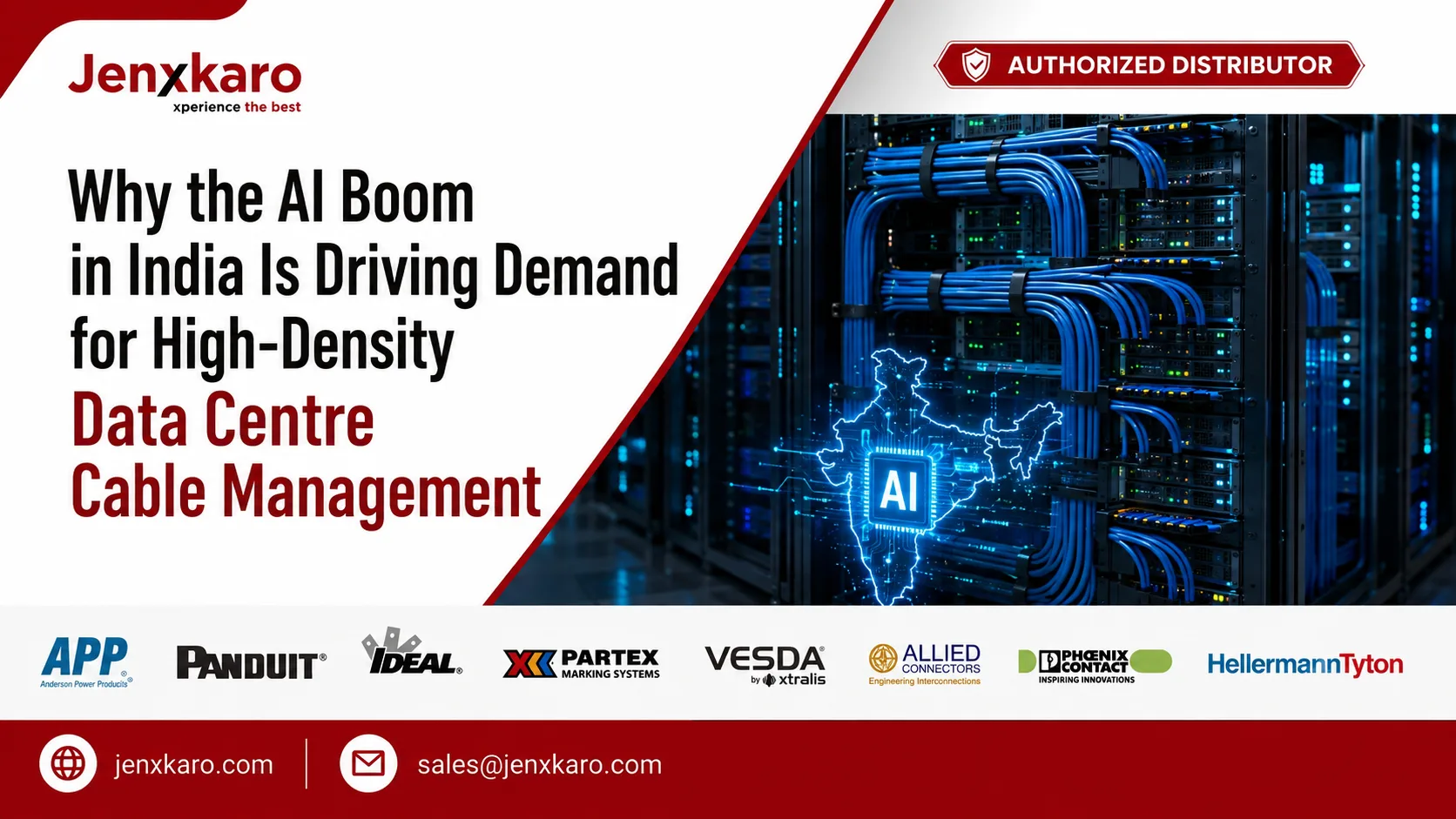
Quick answer: As AI workloads push data centre rack densities in India from the old 3–6 kW range toward 25–30 kW today — and up to hundreds of kW per rack in the near future — the volume of power and fibre cabling per rack is multiplying just as fast. Without proper cable management (structured raceways, rated cable ties, and ventilated cable trays), this extra cabling blocks airflow, creates hotspots, and increases the risk of downtime. Getting cable management right is no longer a housekeeping task; it is now part of the thermal and power design of an AI-ready data centre.
India's Data Centre Boom Is Now an AI Boom
For most of the last decade, India's data centre growth was a colocation and cloud-migration story. That has changed. Industry trackers now describe India's data centre expansion as being driven primarily by artificial intelligence and hyperscale cloud demand rather than traditional enterprise IT. Multiple 2026 market reports point to installed capacity climbing from under 800 MW just a few years ago to somewhere near 1.8–1.9 GW today, with forecasts of 6–9 GW by 2030 depending on how fast AI-linked demand materialises. New supply additions in 2025 and the first half of 2026 have consistently outpaced the previous year's numbers, and several reports now attribute a large share of that growth directly to GPU-heavy, AI-ready facilities rather than standard enterprise racks.
This is not just a "more data centres" story. It is a "denser data centres" story — and density is exactly where cable management stops being cosmetic and starts being an engineering requirement.
Why AI Racks Change the Cabling Equation
A conventional enterprise server rack has historically drawn somewhere around 3 to 6 kW. AI training and inference racks — packed with GPUs, high-bandwidth interconnects, and redundant power feeds — are already running at 25 to 30 kW as a working baseline in new Indian facilities, with some specialised deployments designed for far higher loads as liquid cooling adoption increases. That jump doesn't happen in isolation. Every additional kilowatt of compute typically brings with it:
- More power cabling — additional PDUs, redundant feeds, and heavier-gauge conductors to handle higher current draw.
- More fibre and network cabling — AI clusters depend on extremely high-bandwidth, low-latency interconnects between GPUs and nodes, multiplying the number of fibre runs per rack compared to a standard server rack.
- More termination points — patch panels, connectors, and junctions that all need to be routed, labelled, and secured.
In a standard rack, this extra cabling might be manageable with basic ties and open pathways. In a high-density AI rack, the same approach quickly turns into a physical bottleneck.
The Real Risk: Cable Congestion Blocking Airflow
Here is the part that often gets underestimated until it becomes a maintenance ticket. Data centres — especially air-cooled or hybrid-cooled facilities — depend on predictable, unobstructed airflow to move heat away from compute equipment. When cabling is not routed through proper raceways, ducts, or trays, it tends to bunch up in front of intake vents, behind cabinets, or inside cable trays that were never designed to carry that volume.
The consequences compound quickly:
- Localised hotspots form where blocked airflow lets heat build up around dense GPU clusters, even if the room's overall cooling capacity is adequate.
- Reduced cooling efficiency forces HVAC or CRAC systems to work harder to compensate, raising energy costs at exactly the facilities that are already power-constrained.
- Higher failure risk for cables themselves — tightly packed, unsupported cable bundles are more prone to abrasion, strain, and connector fatigue over time.
- Slower fault diagnosis and maintenance, since untidy, unlabelled cabling makes it harder to trace a single run during a live incident, extending downtime.
In an AI data centre where uptime SLAs are strict and every rack represents a significant capital investment, cable-driven cooling inefficiency is not a minor inconvenience — it is a direct cost and reliability issue.
The Fix: Structured, Rated Cable Management — Not Just "More Ties"
Solving high-density cabling is a design problem as much as a procurement problem. The core components that address it include:
- Rated cable ties for secure, vibration-resistant bundling that doesn't loosen or fail under load — critical when cable bundles are heavier and denser than before. Genuine Panduit cable ties, such as the PLT Series, are engineered specifically for this kind of demanding, high-density environment, with curved-tip designs for easier threading and consistent locking strength.
- Cable tie installation tools, such as the Panduit GTS-E cable tie gun, which allow technicians to apply ties at a consistent tension across large volumes of racks — important when hundreds of AI racks need to be cabled to the same standard.
- Wire ducts and raceways that separate power and data cabling into defined, ventilated pathways instead of letting them share the same open space in front of a rack.
- Cable trays engineered to support higher cable weight and volume while still allowing airflow to pass through, rather than acting as a solid barrier.
- Cable cleats for securing multi-cable power runs — particularly 3-phase power feeds — to ladder racks and trays, keeping cables laterally and axially fixed so they don't shift, sag, or separate under load as bundle weight increases with higher-density power distribution.
- Clear labelling and documented cable routes, so that maintenance teams can trace and service individual runs quickly without disturbing the rest of the bundle.
None of this is exotic technology. It is a disciplined application of proven cable management principles — but applied at a scale and density that most Indian facilities were not originally built for.
Why "Genuine" Components Matter More at High Density
At lower cable densities, a counterfeit or off-brand cable tie that fails might go unnoticed. At AI-rack densities, a single failed tie can let a heavy bundle drop, strain connectors, or partially block an airflow path — with far higher consequences. This is why sourcing from an authorised distributor matters more, not less, as density increases. Genuine Panduit products are manufactured to consistent tensile-strength, temperature-resistance, and locking-mechanism specifications, which is exactly the kind of reliability high-density AI infrastructure depends on. Jenxkaro, powered by Jainsons India Pvt. Ltd., is an authorised Panduit distributor in India, and our full sourcing background is covered in our earlier post on being an authorised Panduit distributor. For guidance on identifying genuine products and choosing a reliable supplier, see our detailed guide on buying authentic Panduit cable ties in India.
A Practical Checklist for Data Centre Teams
If you're specifying or upgrading cable management for an AI-ready facility in India, it helps to work through this sequence:
- Map expected rack power density (kW/rack) for both current load and next-phase expansion.
- Estimate fibre and power cable volume per rack based on redundancy and interconnect requirements.
- Separate power and data pathways using dedicated ducts or raceways wherever possible.
- Choose cable ties and trays rated for the actual bundle weight and environment — not generic, undersized options.
- Standardise installation with proper tools so tension and routing are consistent across every rack, not just the first few.
- Source components from an authorised distributor to avoid inconsistent quality across a large-scale rollout.
Building for India's AI Infrastructure Wave
India's data centre sector is scaling faster than at any point in its history, and AI workloads are the primary reason why. For contractors, system integrators, and facility teams building or retrofitting these sites, cable management is one of the few line items that quietly affects power efficiency, cooling performance, and long-term reliability all at once. Getting it right — with properly rated, genuine components sourced from an authorised distributor — is a small design decision with an outsized impact on how well an AI-ready facility performs once the racks are live.
Planning a data centre build or cabling upgrade? Get in touch with the Jenxkaro team for bulk pricing and stock availability on Panduit, HellermannTyton, Klauke, Anderson Power Cable Cleats, and more.
Where can I source authorised Panduit cable management products in India?
Jenxkaro, powered by Jainsons India Pvt. Ltd., is an authorised Panduit distributor in India and supplies cable ties, installation tools, and related cable management accessories for bulk and project-based data centre requirements. Browse the full range on the Jenxkaro product categories page or explore use-case-specific solutions on the applications page.
Building for India's AI Infrastructure Wave
India's data centre sector is scaling faster than at any point in its history, and AI workloads are the primary reason why. For contractors, system integrators, and facility teams building or retrofitting these sites, cable management is one of the few line items that quietly affects power efficiency, cooling performance, and long-term reliability all at once. Getting it right — with properly rated, genuine components sourced from an authorised distributor — is a small design decision with an outsized impact on how well an AI-ready facility performs once the racks are live.
Planning a data centre build or cabling upgrade? Get in touch with the Jenxkaro team for bulk pricing and stock availability on Panduit, HellermannTyton, Klauke, Anderson Power Cable Cleats, and more.
Jenxkaro
India's 1st electrical components and accessories marketplace.
Frequently asked questions
Why does AI infrastructure need more cable management than traditional data centres?
AI racks carry significantly higher power loads and far more fibre interconnects per rack than standard enterprise servers, which increases both power and network cabling volume. Without structured routing, this extra cabling blocks airflow and raises the risk of hotspots and cable-related failures.What is considered high-density rack cabling in an Indian data centre today?
Industry reports describe Indian AI-ready facilities moving from legacy densities of roughly 3–6 kW per rack to 12–15 kW, with immediate requirements scaling to 25–30 kW, and specialised high-performance racks designed for considerably more.How does cable congestion affect data centre cooling?
Bunched, unrouted cabling in front of intake vents or inside overloaded trays restricts airflow, forcing cooling systems to work harder and creating localised hotspots even when overall room cooling capacity is sufficient.Why choose genuine Panduit cable ties over generic alternatives for data centres?
Genuine Panduit ties are manufactured to consistent tensile-strength and locking specifications, which matters more as bundle weight and density increase — a failed low-quality tie in a high-density rack can strain connectors or interrupt an airflow path.